
A Greedy Adaptive and Backtracking Framework for Reducing Emission Costs in Generator Scheduling
Corresponding email: rfkrhmn@telkomuniversity.ac.id
Published at : 01 Dec 2025
Volume : IJtech
Vol 16, No 6 (2025)
DOI : https://doi.org/10.14716/ijtech.v16i6.7588
Raharjo, J., & Ikhsan, R. (2025). A greedy adaptive and backtracking framework for reducing emission costs in generator scheduling. International Journal of Technology, 16 (6), 2005– 2024.
| Jangkung Raharjo | 1. School of Electrical Engineering, Telkom University, Bandung, Jawa Barat 40257, Indonesia 2. Center of Excellence for Sustainable Energy and Climate Change, Research Institute for Intelligent Busi |
| Rifki Rahman Nur Ikhsan | 1.School of Electrical Engineering, Telkom University, Bandung, Jawa Barat 40257, Indonesia 2. Center of Excellence for Sustainable Energy and Climate Change, Research Institute for Intelligent Busin |
| Lindiasari Martha Yustika | 1. School of Electrical Engineering, Telkom University, Bandung, Jawa Barat 40257, Indonesia 2. Center of Excellence for Sustainable Energy and Climate Change, Research Institute for Intelligent Busi |
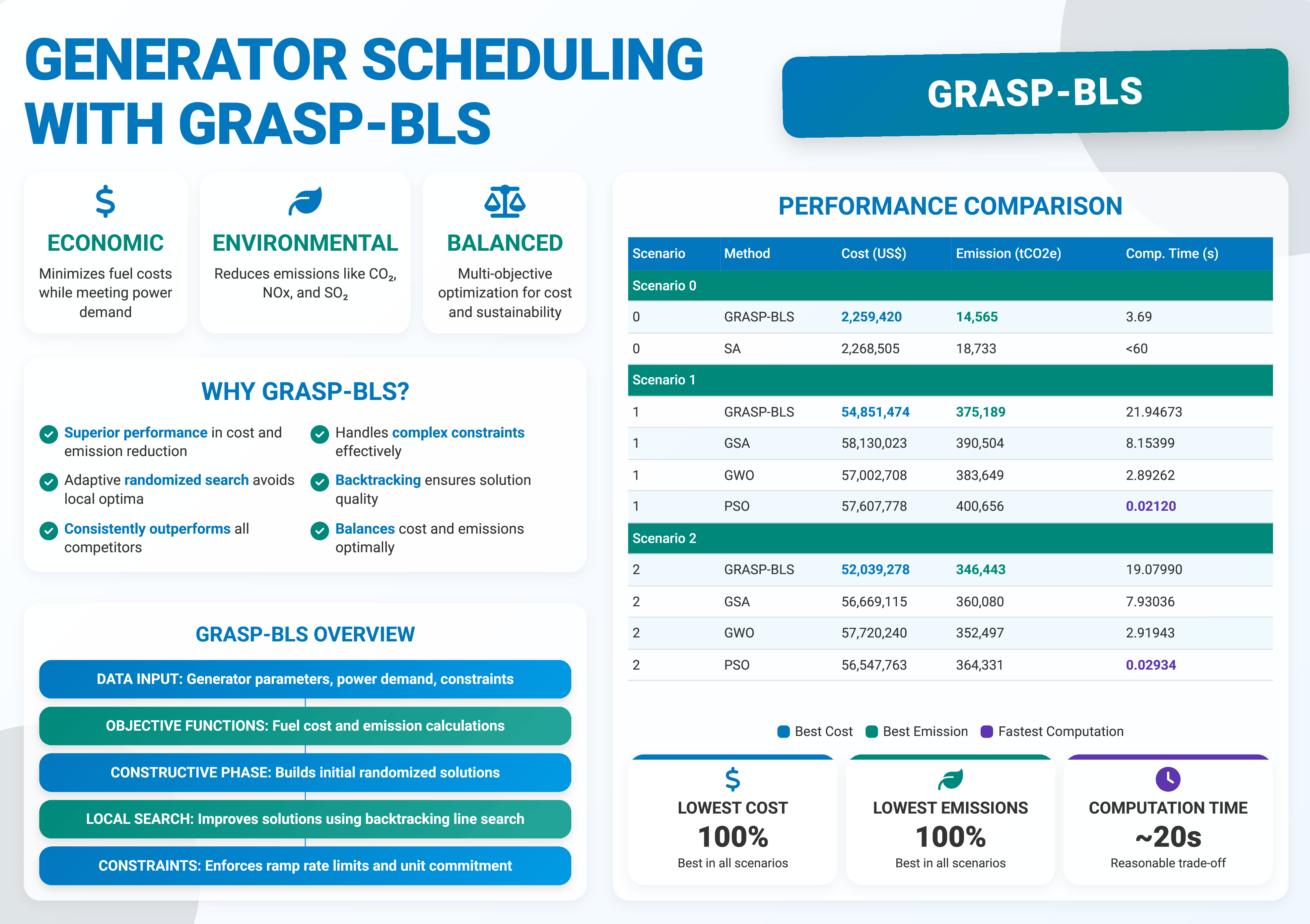
The growing demand for efficient and environmentally sustainable power generation calls for advanced optimization methods to address the economic and emission dispatch (EED) problem. This study introduces a novel hybrid optimization approach, GRASP-BLS, which integrates GRASP for global solution space exploration with BLS for accurate local refinement. The synergy between metaheuristic randomness and gradient-based precision is the main contribution of this work, enabling GRASP-BLS to outperform conventional methods in complex, constrained power dispatch scenarios. In a 4-h test case, GRASP-BLS reduced generation costs by 0.4% and emissions by 22.25% compared with SEA. Extended evaluations over a 24-hour period under two scenarios—Scenario 1 (stable loads) and Scenario 2 (dynamic loads with unit commitment)—show that GRASP-BLS consistently yields superior performance. It achieves 5.64%–9.84% cost savings and 1.72%–4.91% emission reductions, outperforming GSA, GWO, and PSO. Despite slightly higher computation time, GRASP-BLS satisfies all operational constraints, including power balance, generation limits, ramp rates, and unit commitment feasibility. These findings highlight the novelty and practicality of GRASP-BLS as a robust, scalable, and adaptive framework for real-world power system optimization, particularly in environments requiring a balance between economic efficiency and environmental responsibility.
Backtracking Line Search; Economic Emission Dispatch; GRASP; Optimization; Power System
| Filename | Description |
|---|---|
| R3-EECE-7588-20251126160501.docx | --- |
Abbass, K., Qasim, M., Song, H.,
Murshed, M., Mahmood, H., & Younis, I. (2022). A review of the global
climate change impacts, adaptation, and sustainable mitigation measures. Environmental
Science and Pollution Research, 29, 42539–42559. https://doi.org/10.1007/s11356-022-19718-6
Alhasnawi, B., Jasim, B., Bureš, V.,
Sedhom, B., Alhasnawi, A., Abbassi, R., Alsemawai, M., Siano, P., &
Guerrero, J. (2023). A novel economic dispatch in the stand-alone system using
improved butterfly optimization algorithm. Energy Strategy Reviews, 49,
101135. https://doi.org/10.1016/j.esr.2023.101135
Asl, A., & Overton, M. (2017).
Analysis of the gradient method with an Armijo-Wolfe line search on a class of
nonsmooth convex functions. Optimization Methods and Software, 35,
223–242. https://doi.org/10.1080/10556788.2019.1673388
Aswan, N., Abdullah, M., & Bakar,
A. (2019). A review of combined economic emission dispatch for optimal power
dispatch with renewable energy. Indonesian Journal of Electrical Engineering
and Computer Science, 16, 33–40. https://doi.org/10.11591/ijeecs.v16.i1.pp33-40
Bhattacharjee, K., Bhattacharya, A.,
& Dey, S. (2014). Chemical reaction optimization applied in economic
dispatch problems. 1st International Conference on Automation, Control,
Energy and Systems (ACES 2014). https://doi.org/10.1109/ACES.2014.6807995
Brata, J., & Toparakkasi, F.
(2023). Public policies for climate change mitigation in Indonesia. Jurnal
Aktor, 2, 103–110. https://doi.org/10.26858/aktor.v2i3.46879
Cavalcanti, J. V., Lessard, L., &
Wilson, A. (2024). Adaptive backtracking for faster optimization
[Manuscript in preparation]. (Accessed 2025)
Chaudhary, V., Dubey, H., Pandit, M.,
& Salkuti, S. (2024). A chaotic Jaya algorithm for environmental economic
dispatch incorporating wind and solar power. AIMS Energy, 12, 1–30. https://doi.org/10.3934/energy.2024001
Chaves, A., Resende, M., & Silva,
R. (2024). A random-key GRASP for combinatorial optimization
[Unpublished manuscript].
Estrada-Padilla, A., Gómez-Santillán,
C., Fraire-Huacuja, H., Cruz-Reyes, L., Rangel-Valdez, N., Morales-Rodríguez,
M., & Puga-Soberanes, H. (2022). GRASP/?: An efficient algorithm for the
multi-objective portfolio optimization problem. SSRN Electronic Journal.
https://doi.org/10.2139/ssrn.4070763
Farida, W., Iqbal, A., Iswahyudi, M.,
& Akuntansi, J. (2024). Mapping sustainable development goals (SDGs)
research landscape in Indonesia: A bibliometric analysis. Jurnal Pendidikan
Akuntansi & Keuangan, 12, 162–178. https://doi.org/10.17509/jpak.v12i2.69422
Habachi, R., Touil, A., Boulal, A.,
Charkaoui, A., & Echchatbi, A. (2019). Economic and emission dispatch using
cuckoo search algorithm. International Journal of Electrical and Computer
Engineering, 9, 3384–3390. https://doi.org/10.11591/ijece.v9i5.pp3384-3390
Hadi, I., Yola, L., Hanifa, A., &
Muzhaffar, M. (2025). Decarbonization strategy towards net zero emission for
international shipping on Indonesian archipelagic sea lanes. International
Journal of Technology, 16, 8–26. https://doi.org/10.14716/ijtech.v16i1.7106
Hirsch, M., Pardalos, P., &
Resende, M. (2010). Speeding up continuous GRASP. European Journal of
Operational Research, 205, 507–521. https://doi.org/10.1016/j.ejor.2010.02.009
Hong, Y., & Apolinario, G. (2021).
Uncertainty in unit commitment in power systems: A review of models, methods,
and applications. Energies, 14, 6658. https://doi.org/10.3390/en14206658
Ikhsan, R., Raharjo, J., & Rahmat, B. (2024). Vectorized lambda
iteration method for swift economic dispatch analysis. Evergreen, 11,
435–447. https://doi.org/10.5109/7172306
Intan Laily Muflikhah, Raharjo, J.,
& Sastrosubroto, A. S. (2024). Optimasi economic emission dispatch
menggunakan whale optimization algorithm untuk penentuan biaya reduksi emisi. ELKOMIKA, 12, 468. https://doi.org/10.26760/elkomika.v12i2.468
Jayanthi, N., Sudibia, I., Dewi, M., & Yasa, I. (2024). Implementation
of the sustainable development goals (SDGs) program in Indonesia: Literature
review analysis. International Research Journal of Economics and Management
Studies, 3, 497–502. https://doi.org/10.56472/25835238/irjems-v3i1p153
Kamboj, V., & Malik, O. (2023).
Optimal unit commitment and generation scheduling of integrated power systems
with plug-in electric vehicles and renewable energy sources. Energies, 17,
123. https://doi.org/10.3390/en17010123
Kunstner, F., Portella, V., Schmidt,
M., & Harvey, N. (2023). Searching for optimal per-coordinate step-sizes
with multidimensional backtracking [Preprint]. NeurIPS, 36.
Laguna, M., Martí, R., Martí, M.,
Martinez-Gavara, A., Perez-Pelo, S., Pelo, P., & Resende, M. (2023). 20
years of GRASP with path relinking [Unverified publication].
Lup, A., Soni, V., Keenan, B., Son, J.,
Taghartapeh, M., Morato, M., Poya, Y., & Montañés, R. (2023). Sustainable
energy technologies for the global south: Challenges and solutions toward
achieving SDG 7. Environmental Science: Advances, 2, 570–585. https://doi.org/10.1039/d2va00247g
Marouani, I., Guesmi, T., Abdallah, H.,
Alshammari, B., Alqunun, K., Alshammari, A., & Rahmani, S. (2022). Combined
economic emission dispatch with and without consideration of PV and wind energy
by using various optimization techniques: A review. Energies, 15, 4472. https://doi.org/10.3390/en15124472
Marzbani, F., & Abdelfatah, A.
(2024). Economic dispatch optimization strategies and problem formulation: A
comprehensive review. Energies,
17. https://doi.org/10.3390/en17030550
Minas, A. M., García-Freites, S., Walsh, C., Mukoro, V., Aberilla, J. M.,
April, A., Kuriakose, J., Gaete-Morales, C., Schmid, A. G., & Mander, S.
(2024). Advancing sustainable development goals through energy access:
Lessons from the global south. Renewable and Sustainable Energy Reviews, 199,
114457. https://doi.org/10.1016/j.rser.2024.114457
Neto, J., Reynoso-Meza, G., Ruppel, T.,
Mariani, V., & Coelho, L. (2017). Solving non-smooth economic dispatch by a
new combination of continuous GRASP algorithm and differential evolution. International
Journal of Electrical Power & Energy Systems, 84, 13–24. https://doi.org/10.1016/j.ijepes.2016.04.012
Niu, Q., You, M., Yang, Z., &
Zhang, Y. (2021). Economic emission dispatch considering renewable energy
resources: A multi-objective cross entropy optimization approach. Sustainability,
13, 5386. https://doi.org/10.3390/su13105386
Nuzula, V., Farida, L., & Sosial,
K. (2024). Implementation of sustainable development goals (SDGs) in Indonesia
from an Islamic economic perspective. Al-Tsaman: Jurnal Ekonomi dan Keuangan Islam, 6, 82–93. https://doi.org/10.62097/al-tsaman.v6i02.2006
Okelola, M., Adekilekun, T. M., & Gafari, A. (2023). Economic
dispatch problem solution of power system using artificial intelligence-based
hybrid optimization method. Adeleke University Journal of Engineering and
Technology, 6, 33–45.
O’Neill, M., & Wright, S. (2023). A
line-search descent algorithm for strict saddle functions with complexity
guarantees. Journal of Machine Learning Research, 24, 1–34.
Onibonoje, M., Alegbeleye, O., &
Ojo, A. (2023). Control design and management of a distributed energy resources
system. International Journal of Technology, 14, 236–245. https://doi.org/10.14716/ijtech.v14i2.5884
Oviedo-Salas, E., Terán-Villanueva, J.,
Ibarra-Martínez, S., Santiago-Pineda, A., Ponce-Flores, M., Laria-Menchaca, J.,
Castañ-Rocha, J., & Treviño-Berrones, M. (2022). GRASP optimization for the
strip packing problem with flags, waste functions, and an improved restricted
candidate list. Applied Sciences, 12, 1965. https://doi.org/10.3390/app12041965
Puspitasari, K., Raharjo, J.,
Sastrosubroto, A., & Rahmat, B. (2022). Generator scheduling optimization
involving emission to determine emission reduction costs. International
Journal of Engineering, 35, 1468–1478. https://doi.org/10.5829/ije.2022.35.08b.02
Raharjo, J., Zein, H., & Adam, K.
(2021). Optimal economic load dispatch with prohibited operating zones using
large to small area technique. International Journal on Energy Conversion, 9,
29–34. https://doi.org/10.15866/irecon.v9i1.19548
Resende, M., & Ribeiro, C. (2014).
GRASP: Greedy randomized adaptive search procedures. In Search methodologies
(pp. 287–312). Springer. https://doi.org/10.1007/978-1-4614-6940-7_11
Resende, M., & Ribeiro, C. (2019).
Greedy randomized adaptive search procedures: Advances and extensions. In International
series in operations research and management science (Vol. 272, pp.
169–220). Springer. https://doi.org/10.1007/978-3-319-91086-4_6
Ryan, B., & Bristow, D. (2023).
Climate change and hygrothermal performance of building envelopes: A review on
risk assessment. International Journal of Technology, 14, 1461–1475. https://doi.org/10.14716/ijtech.v14i7.6666
Saroji, G., Berawi, M., Sari, M.,
Madyaningarum, N., Socaningrum, J., Susantono, B., & Woodhead, R. (2022).
Optimizing the development of power generation to increase the utilization of
renewable energy sources. International Journal of Technology, 13,
1422–1431. https://doi.org/10.14716/ijtech.v13i7.6189
Selvakumar, K., Selvabharathi, D.,
Palanisamy, R., & Thentral, T. T. (2023). CO? emission-constrained
short-term unit commitment problem using shuffled frog leaping algorithm. Journal
of Electrical and Computer Engineering, 2023, 2336689. https://doi.org/10.1155/2023/2336689
Shah, K., Soni, J., &
Bhattacharjee, K. (2023). Artificial electric field algorithm applied to the
economic load dispatch problem with valve point loading effect. International
Journal of Swarm Intelligence Research, 14, 1–23. https://doi.org/10.4018/ijsir.317136
Sharifian, Y., & Abdi, H. (2023).
Solving multi-area economic dispatch problem using hybrid exchange market
algorithm with grasshopper optimization algorithm. Energy, 267, 126550. https://doi.org/10.1016/j.energy.2022.126550
Sharifian, Y., & Abdi, H. (2024).
Multi-area economic dispatch problem: Methods, uncertainties, and future
directions. Renewable and Sustainable Energy Reviews, 191, 114093. https://doi.org/10.1016/j.rser.2023.114093
Shea, B., & Schmidt, M. (2024). Greedy
Newton: Newton’s method with exact line search [Preprint]. https://doi.org/10.48550/arXiv.2401.06809
Soni, J., & Bhattacharjee, K.
(2022). Sooty tern optimization algorithm for solving the multi-objective
dynamic economic emission dispatch problem. International Journal of Swarm
Intelligence Research, 13, 1–15. https://doi.org/10.4018/ijsir.308292
Soni, J., & Bhattacharjee, K.
(2023). Equilibrium optimiser for the economic load dispatch problem with
multiple fuel option and renewable sources. International Journal of Ambient
Energy, 44, 2386–2397. https://doi.org/10.1080/01430750.2023.2237018
Soni, J., & Bhattacharjee, K.
(2024a). Equilibrium optimizer for multi-objective dynamic economic emission
dispatch integration with plug-in electric vehicles and renewable sources. Multiscale
and Multidisciplinary Modeling, Experiments and Design, 7, 2683–2699. https://doi.org/10.1007/s41939-023-00346-7
Soni, J., & Bhattacharjee, K.
(2024b). Integrating renewable energy sources and electric vehicles in dynamic
economic emission dispatch: An oppositional-based equilibrium optimizer
approach. Engineering Optimization. https://doi.org/10.1080/0305215x.2023.2285896
Stanimirovi?, P., & Miladinovi?, M.
(2010). Accelerated gradient descent methods with line search. Numerical
Algorithms, 54, 503–520. https://doi.org/10.1007/s11075-009-9350-8
Stefan Pfenninger-Lee, Hammoud, H.,
Starreveld, J., Bruninx, K., Lafeber, M., van Nieuwstadt, S., & Lukszo, Z.
(2024). Economic dispatch as a linear optimisation problem. https://www.modelling-energy-systems.org/basics/dispatch-lp
(Accessed March 28, 2025)
Syama, S., Ramprabhakar, J., Anand, R.,
& Guerrero, J. (2024). An integrated binary metaheuristic approach in
dynamic unit commitment and economic emission dispatch for hybrid energy
systems. Scientific Reports, 14, 1–37. https://doi.org/10.1038/s41598-024-75743-0
Tijani, M. A., Adewale, A. M.,
Akinloye, O. T., & Sodiq, A. O. (2024). Economic and emission dispatch of
power system using bat algorithm. 4th International Conference and
Exhibition for School of Engineering.
Tsai, H., Chen, Y., & Ko, C.
(2024). Advanced backtracking search for solving continuous optimization
problems. Soft Computing, 28, 7905–7918. https://doi.org/10.1007/s00500-024-09716-w
Wachjoe, C., Zein, H., & Raharjo, J. (2020). A fast scheduling
method to solve economic load dispatch problem. International Review of
Automatic Control, 13, 12–18. https://doi.org/10.15866/ireaco.v13i1.18130
Wance, M., Herizal, H., Alwi, A.,
Syahidah, U., & Damasinta, A. (2024). Trend of climate change mitigation
policy publication in Indonesia: A systematic review. Journal of Government
Science Studies, 3, 113–126. https://doi.org/10.30598/jgssvol3issue2page113-126
Wang, X., Wang, S., Ren, J., Song, Z.,
Zhang, S., & Feng, H. (2024). Optimizing economic dispatch for microgrid
clusters using improved grey wolf optimization. Electronics, 13, 3139. https://doi.org/10.3390/electronics13163139
Xu, X., Hu, Z., Su, Q., Xiong, Z.,
& Liu, M. (2021). Multi-objective learning backtracking search algorithm
for economic emission dispatch problem. Soft Computing, 25,
2433–2452. https://doi.org/10.1007/s00500-020-05312-w
Yang, W., Zhang, Y., Zhu, X., Li, K., & Yang, Z. (2024). Research
on dynamic economic dispatch optimization problem based on improved grey wolf
algorithm. Energies, 17, 1491. https://doi.org/10.3390/en17061491
Zagloel, T., Harwahyu, R., Maknun, I.,
Kusrini, E., & Whulanza, Y. (2023). Developing models and tools for
exploring the synergies between energy transition and the digital economy. International
Journal of Technology, 14, 1615–1622. https://doi.org/10.14716/ijtech.v14i8.6906
Zein, H., Raharjo, J., & Mardiyanto, I. (2022). A method for completing economic load dispatch using the technique of narrowing down area. IEEE Access, 10, 30822–30831. https://doi.org/10.1109/access.2022.3158928