
Neuro-Fuzzy Inference System for Accurate Prediction of Z-Axis Values in Screw Installation
Published at : 01 Dec 2025
Volume : IJtech
Vol 16, No 6 (2025)
DOI : https://doi.org/10.14716/ijtech.v16i6.7557
Roesyadi, B., & Sahroni, T. (2025). Neuro-fuzzy inference system for accurate prediction of zaxis values in screw installation. International Journal of Technology, 16 (6), 1985–2004.
| Bhakti Pradana Roesyadi | Industrial Engineering Departement, BINUS Graduate Program - Master of Industrial Engineering, Bina Nusantara University, 11480, Jakarta, Indonesia |
| Taufik Roni Sahroni | Industrial Engineering Departement, BINUS Graduate Program - Master of Industrial Engineering, Bina Nusantara University, 11480, Jakarta, Indonesia |
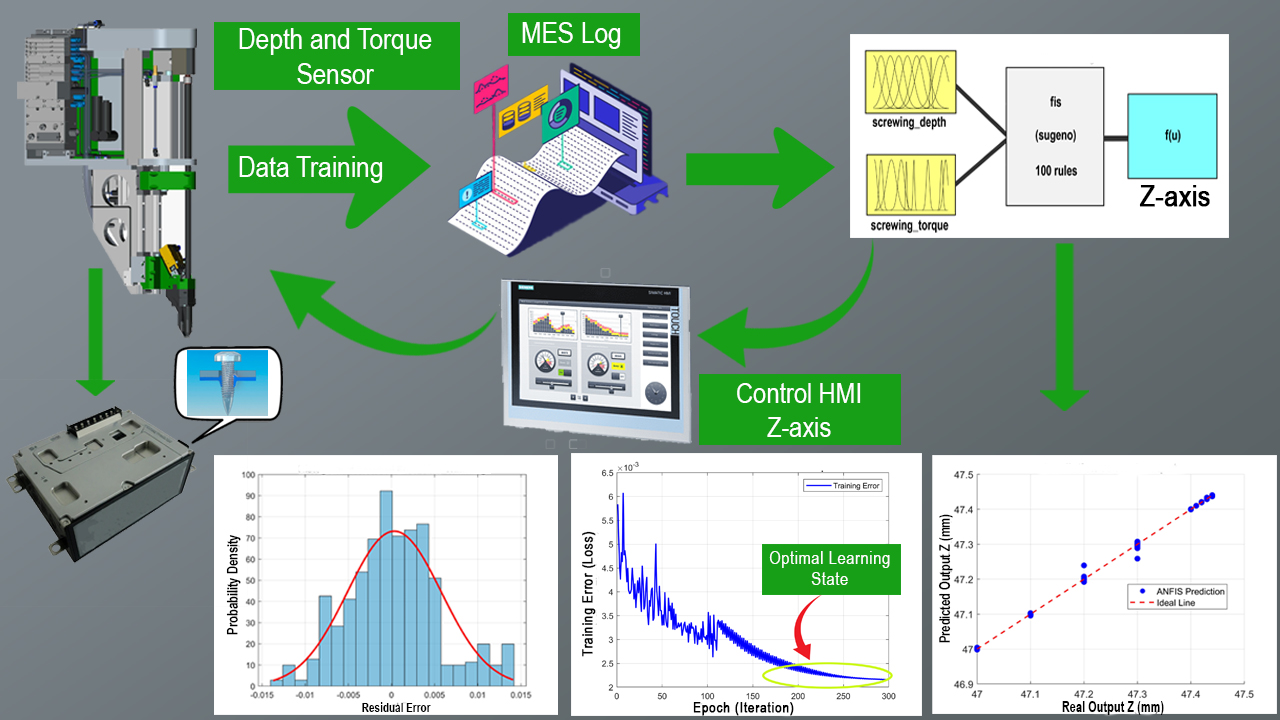
High precision in automated screw installation is crucial for ensuring product quality and operational efficiency in modern manufacturing. A key challenge is accurately predicting the Z-axis value based on screwing depth and torque, which exhibit complex nonlinear relationships. This study proposes an Adaptive Neuro-Fuzzy Inference System (ANFIS) model to enhance predictive accuracy. Experimental data are collected by varying the mounting depth and torque and then preprocessed through normalization before training the model. The ANFIS model is designed with fuzzy membership functions and trained using a hybrid learning algorithm. The performance evaluation using the root mean squared error (RMSE) has a value of 2.52 × 10⁻³, indicating high prediction accuracy. Residual error analysis revealed a near-normal distribution after transformation, with skewness of 0.2672 and kurtosis of 3.1112. Error analysis on extreme Z values revealed a mean residual error of 1.34 × 10⁻² for low Z (< 47.1) and 0.0091247 for high Z (> 47.4), confirming the model’s reliability. The Kruskal-Wallis test further validates ANFIS’s superiority over Support Vector Regression (SVR) and Random Forest Regression (RFR), with an H-value of 115.62 and a p-value of 0.000. The results demonstrate that ANFIS effectively captures the dependencies between input parameters and Z values, achieving minimal deviation from the actual values. This research contributes to intelligent manufacturing by enabling predictive monitoring and adaptive control. Additionally, it aligns with Sustainable Development Goal (SDG) 9 by promoting resilient infrastructure and sustainable industrialization. Future work may explore the integration of real-time sensor feedback or the hybridization of ANFIS with deep learning for enhanced adaptability in dynamic industrial settings.
ANFIS; Mounting depth; Mounting torque; Predictive modelling; Precision assembly
| Filename | Description |
|---|---|
| R4-IE-7557-20251127144324.docx | --- |
AbouElaz, M., Alhasnawi, B., Sedhom,
B., & Bure?s, V. (2025). Anfis-optimized control for resilient and
efficient supply chain performance in smart manufacturing. Results in
Engineering, 25. https://doi.org/https://doi.org/10.1016/j.rineng.2025.104262
Ajala, O. O., Oke, E. O., Odejobi, O.
J., Adeoye, B. K., & Oyelade, J. O. (2023). Artifi- cial neuro-fuzzy
intelligent prediction of techno-economic parameters of computer-aided scale-up
for palm kernel oil based biodiesel production. Cleaner Chemical Engineering,
5, 100098. https://doi.org/https://doi.org/10.1016/j.clce.2023.100098
Akkaya, E. (2016). Anfis based
prediction model for biomass heating value using proximate analysis components.
Fuel, 180, 687–693. https://doi.org/https://doi.org/10.1016/j.fuel.2016.04.112
Alazzam, A., & Tashtoush, T.
(2021). Lead-free solder reliability modeling using adaptive neuro- fuzzy
inference system (anfis). Jordan Journal of Mechanical and Industrial Engineering,
15, 181–189.
Azad, A., Farzin, S., Kashi, H., et al. (2018). Prediction of river
flow using hybrid neurofuzzy models [Received 04 May 2018; Accepted 15 November
2018; Published 23 November 2018]. Arab Journal of Geosciences, 11, 718. https://doi.org/10.1007/s12517-018-4079-0
Azhar, N. A. C., Chockalingam, P.,
Perumal, L., & Wen, C. C. (2023). Fuzzy logic modelling for microwave heat
treatment of aluminium sheet. International Journal of Technology, 14 (2),
434–442. https://doi.org/https://doi.org/10.14716/ijtech.v14i2.5578
Castell ?oes, T. d. O., Rizol, P. M. S.
R., & Nascimento, L. F. C. (2024). Association between premature birth and
air pollutants using fuzzy and adaptive neuro-fuzzy inference system (anfis)
techniques. Mathematics, 12 (18). https://doi.org/10.3390/math12182828
Danylova, L., Lapkovskyi, S., &
Prykhodko, V. (2022). Peculiarities of calculating the diameter of the hole for
setting the thread-forming part. Mechanics and Advanced Technologies, 6 (2),
151–160. https://doi.org/10.20535/2521-1943.2022.6.2.264828
Dat, T. T. K., & Phuc, T. T.
(2024). Prediction of actual toolpath and enhancement of the toolpath accuracy
based on identification of feedrate change characteristics of machine tool.
International Journal of Technology, 15 (3), 531–543. https://doi.org/https://doi.org/10.14716/ijtech.v15i3.6363
Deshwal, S., Kumar, A., & Chhabra, D. (2020). Exercising hybrid
statistical tools garsm, gaann and gaanfis to optimize fdm process parameters
for tensile strength improvement. CIRP Journal of Manufacturing Science and
Technology, 31, 189–199. https://doi.org/https://doi.org/10.1016/j.cirpj.2020.05.009
Dhar, A. R., Gupta, D., & Roy, S.
S. (2021). Development of a bi- directional multi- input- multi-output
predictive model for the fused deposition modelling process using coactive
adaptive neuro-fuzzy inference system. IOP Conference Series: Materials Science
and Engineering, 1136 (1), 012007. https://doi.org/10.1088/1757-899X/1136/1/012007
George, J., & Mani, G. (2024). A
portrayal of sliding mode control through adaptive neuro fuzzy inference system
with optimization perspective. IEEE Access, 12, 3222–3239. https://doi.org/10.1109/ACCESS.2023.3348836
Ghashami, F., & Kamyar, K. (2021). Lead-free solder reliability
modeling using adaptive neurofuzzy inference system (anfis). Performance
Evaluation of ANFIS and GAANFIS for Predicting Stock Market Indices, 13, 1.
Guan, W., Yi, Q., Mo, Q., Jiang, T., Wang, S., & Lei Zhao, Y. (2024). Study
on the tightening scheme of electronic component screw assemblies based on
finite element simulation. Journal of Physics: Conference Series, 2859 (1),
012005. https://doi.org/10.1088/1742-6596/2859/1/012005
G ?uneri, A. F., Ertay, T., & Y ?ucel, A. (2011). An approach
based on anfis input selection and modeling for supplier selection problem.
Expert Systems with Applications, 38 (12), 14907–14917. https://doi.org/10.1016/j.eswa.2011.05.056
Halim & Sahroni. (2023). Mooney
viscosity rubber mixing process model using adaptive neurofuzzy inference
system (anfis) method towards smart manufacturing. Master’s Thesis, BINUS
University, Jakarta, Indonesia.
Hossain, M. S. J., & Ahmad, N.
(2014). A neuro-fuzzy approach to select cutting parameters for commercial die
manufacturing [10th International Conference on Mechanical Engineering, ICME
2013]. Procedia Engineering, 90, 753–759. https://doi.org/10.1016/j.proeng.2014.11.809
Hussein, A. M. (2016). Adaptive
neuro-fuzzy inference system of friction factor and heat transfer nanofluid
turbulent flow in a heated tube. Case Studies in Thermal Engineering, 8,
94–104. https://doi.org/10.1016/j.csite.2016.06.001
Hynes, R., & Kumar, R. (2017). Process
optimization for maximizing bushing length in thermal drilling using integrated
ann-sa approach. Journal of the Brazilian Society of Mechanical Sciences and
Engineering, 39. https://doi.org/10.1007/s40430-017-0820-y
Jeffrey L. Dapito, A. Y. C. (2024). Coefficient of performance
prediction model for an on-site vapor compression refrigeration system using
artificial neural network. International Journal of Technology, 15 (3),
505–516. https://doi.org/10.14716/ijtech.v15i3.6728
Karaboga, D., & Kaya, E. (2019).
Adaptive network based fuzzy inference system (anfis) training approaches: A
comprehensive survey [Published 03 January 2018; Issue Date December 2019].
Artificial Intelligence Review, 52, 2263–2293. https://doi.org/10.1007/s10462-017-9610-2
Kassem, Y., C ? amur, H., & Bennur, K. (2018). Adaptive
neuro-fuzzy inference system (anfis) and artificial neural network (ann) for
predicting the kinematic viscosity and density of biodiesel-petroleum diesel
blends. American Journal of Computer Science and Technology, 1 (1), 8–18. https://doi.org/10.11648/j.ajcst.20180101.12
Khorasani, A., Soleymani Y., R., Mohammad., & Safizadeh, M. (2011). Tool
life prediction in face milling machining of 7075 al by using artificial neural
networks (ann) and taguchi design of experiment (doe). International Journal of
Engineering and Technology. https://doi.org/10.7763/IJET.2011.V3.196
Kiran, T. R., & Rajput, S. (2011). An
effectiveness model for an indirect evaporative cooling (iec) system:
Comparison of artificial neural networks (ann), adaptive neurofuzzy inference
system (anfis) and fuzzy inference system (fis) approach. Applied Soft
Computing, 11 (4), 3525–3533. https://doi.org/https://doi.org/10.1016/j.asoc.2011.01.025
Kumar, R., & Hynes, N. (2020). Prediction and optimization of
surface roughness in thermal drilling using integrated anfis and ga approach.
Engineering Science and Technology, an International Journal, 23 (1), 30–41. https://doi.org/10.1016/j.jestch.2019.04.011
Kumar, S., & Bansal, S. (2023).
Performance evaluation of anfis and rsm in modeling biodiesel synthesis from
soybean oil. Biosensors and Bioelectronics: X, 15, 100408. https://doi.org/10.1016/j.biosx.2023.100408
Liu, F., Wang, H., Shi, Q., Wang, H., Zhang, M., & Zhao, H. (2017). Comparison
of an anfis and fuzzy pid control model for performance in a two-axis inertial
stabilized platform. IEEE Access, 5, 12951–12962. https://doi.org/10.1109/ACCESS.2017.2723541
Liu, Y., Song, B., Zhou, X., Gao, Y.,
& Chen, T. (2023). An adaptive torque observer based on fuzzy inference for
flexible joint application. Machines, 11 (8). https://doi.org/10.3390/machines11080794
Luis P ?erez, C. J. (2020). A proposal
of an adaptive neuro-fuzzy inference system for modeling experimental data in
manufacturing engineering. Mathematics, 8 (9). https://doi.org/10.3390/math8091390
Machesa, M. G. K., Tartibu, L. K.,
Tekweme, F. K., & Okwu, M. O. (2019). Evaluation of the stirling heat
engine performance prediction using ann-pso and anfis models. 2019 6th
International Conference on Soft Computing Machine Intelligence (ISCMI),
217–222. https://doi.org/10.1109/ISCMI47871.2019.9004406
Maher, I., Eltaib, M. E. H., Sarhan, A. A. D., et al. (2014).
Investigation of the effect of machining parameters on the surface quality of
machined brass (60/40) in cnc end milling—anfis modeling [Received 25 December
2013; Accepted 28 May 2014; Published 07 June 2014; Issue Date September 2014].
International Journal of Advanced Manufacturing Technology, 74, 531–537. https://doi.org/10.1007/s00170-014-6016-z
Melin, P., Soto, J., Castillo, O.,
& Soria, J. (2012). A new approach for time series prediction using
ensembles of anfis models. Expert Systems with Applications, 39 (3), 3494–3506.
https://doi.org/10.1016/j.eswa.2011.09.040
Mohamed, R. A. (2022). Modeling of
dielectric behavior of polymers nanocomposites using adaptive neuro-fuzzy
inference system (anfis) [Received 07 September 2021; Accepted 23 February
2022; Published 23 March 2022]. European Physical Journal Plus, 137, 384. https://doi.org/10.1140/epjp/s13360-022-02518-9
Mostafaei, M. (2018). Prediction of
biodiesel fuel properties from its fatty acids composition using anfis
approach. Fuel, 229, 227–234. https://doi.org/10.1016/j.fuel.2018.04.148
Navarro, I. (2013). Study of a neural
network-based system for stability augmentation of an airplane [Master’s
thesis]. Universitat Polit`ecnica de Catalunya [Accessed: 2025-01-09]. http://hdl.handle.net/2099.1/20296
Noorsaman, A., Amrializzia, D.,
Zulfikri, H., Revitasari, R., & Isambert, A. (2023). Machine learning
algorithms for failure prediction model and operational reliability of onshore
gas transmission pipelines. International Journal of Technology, 14 (3), 680–689.
https://doi.org/10.14716/ijtech.v14i3.6287
Pano-Azucena, A. D., Tlelo-Cuautle, E.,
& Tan, S. X.-D. (2018). Prediction of chaotic time series by using anns,
anfis and svms. 2018 7th International Conference on Modern Circuits and
Systems Technologies (MOCAST), 1–4. https://doi.org/10.1109/MOCAST.2018.8376560
Podder, B., Banerjee, P., Kumar, K. R.,
& Hui, N. B. (2017). Development of anfis model for flow forming of
solution annealed h30 aluminium tubes. Precision Machining IX, 261, 378–385. https://doi.org/10.4028/www.scientific.net/SSP.261.378
Rahman, A., Hassan, N., & Ihsan, S. I. (2022). Fuzzy logic
controlled two speed electromagnetic gearbox for electric vehicle.
International Journal of Technology, 13 (2), 297–309. https://doi.org/10.14716/ijtech.v13i2.3913
Rao, K. B., & Reddy, D. M. (2023). Fault diagnosis in rotors
using adaptive neurofuzzy inference systems. Proceedings of the Institution of
Mechanical Engineers, Part C: Journal of Mechanical Engineering Science, 237
(12), 2714–2728. https://doi.org/10.1177/09544062221141588
Saghaei, A., & Didehkhani, H.
(2011). Developing an integrated model for the evaluation and selection of six
sigma projects based on anfis and fuzzy goal programming. Expert Systems with
Applications, 38 (1), 721–728. https://doi.org/10.1016/j.eswa.2010.07.024
Sarhadi, P., Rezaie, B., & Rahmani, Z. (2016). Adaptive
predictive control based on adaptive neuro-fuzzy inference system for a class
of nonlinear industrial processes. Journal of the Taiwan Institute of Chemical
Engineers, 61, 132–137. https://doi.org/10.1016/j.jtice.2015.03.019
Sari, M., Berawi, M., Larasati, S.,
Susilowati, S., Susantono, B., & Woodhead, R. (2023). Developing machine
learning model to predict hvac system of healthy building: A case study in
indonesia. International Journal of Technology, 14 (7), 1438–1448. https://doi.org/10.14716/ijtech.v14i7.6682
Sari, M., Berawi, M. A., Larasati, S.
P., Susilowati, S. I., Susantono, B., & Woodhead, R. (2023). Developing
machine learning model to predict hvac system of healthy building: A case study
in indonesia. International Journal of Technology, 14 (7), 1438–1448. https://doi.org/10.14716/ijtech.v14i7.6682
Saw, L. H., Ho, L. W., Yew, M. C.,
Yusof, F., Pambudi, N. A., Ng, T. C., & Yew, M. K. (2018). Sensitivity
analysis of drill wear and optimization using adaptive neuro fuzzy –genetic
algorithm technique toward sustainable machining. Journal of Cleaner
Production, 172, 3289–3298. https://doi.org/10.1016/j.jclepro.2017.10.303
Shoorehdeli, M., Teshnehlab, M., & Sedigh, A. (2006). A novel
training algorithm in anfis structure. 2006 American Control Conference, 6
pp.-. https://doi.org/10.1109/ACC.2006.1657525
Sri, K. S., Nayaka, R. R., & Kumar, M. V. N. S. (2023). Mechanical
properties of sustainable self-healing concrete and its performance evaluation
using ann and anfis models [Received 25 April 2023; Revised 11 September 2023;
Accepted 12 September 2023; Published 29 September 2023]. Journal of Building
Rehabilitation, 8, 99. https://doi.org/10.1007/s41024-023-00345-8
Surajudeen-Bakinde, N. T., Faruk, N.,
Popoola, S. I., Salman, M. A., Oloyede, A. A., Olawoyin, L. A., & Calafate,
C. T. (2018). Path loss predictions for multi-transmitter radio propagation in
vhf bands using adaptive neuro-fuzzy inference system. Engineering Science and
Technology, an International Journal, 21 (4), 679–691. https://doi.org/10.1016/j.jestch.2018.05.013
Tsenev, V., Videkov, V., & Spasova,
N. (2021). Installation of electronic modules in a housing by means of a screw
assembly and assessment of the influence of the deformation of the pcb on the
installed components. 2021 International Conference on Information Technologies
(InfoTech), 1–4. https://doi.org/10.1109/InfoTech52438.2021.9548353
Zare, M., & Vahdati Khaki, J.
(2012). Prediction of mechanical properties of a warm compacted molybdenum
prealloy using artificial neural network and adaptive neurofuzzy models.
Materials Design, 38, 26–31. https://doi.org/10.1016/j.matdes.2012.01.042