
Validation of a Temporary External Fixator for Mandibular Reconstruction: A Biomechanical and Finite Element Analysis
Corresponding email: apicbo@kku.ac.th
Published at : 01 Dec 2025
Volume : IJtech
Vol 16, No 6 (2025)
DOI : https://doi.org/10.14716/ijtech.v16i6.7849
| Rungsan Chaiyachet | Department of Mechanical and Manufacturing, Engineering, Faculty of Science and Engineering, Kasetsart University, Sakon Nakhon, 47000, Thailand |
| Weerayut Jina | Department of Mechanical and Manufacturing, Engineering, Faculty of Science and Engineering, Kasetsart University, Sakon Nakhon, 47000, Thailand |
| Ekkachai Kanchanatip | Department of Civil and Environmental Engineering, Faculty of Science and Engineering, Kasetsart University, Sakon Nakhon, 47000, Thailand |
| Teerawat Paipongna | Dental Department, Sakon Nakhon Hospital, Sakon Nakhon, 47000, Thailand |
| Surasith Piyasin | Department of Mechanical Engineering, Faculty of Engineering, Khon Kaen University, Khon Kaen, 40002, Thailand |
| Apichart Boonma | Department of Industrial Engineering, Faculty of Engineering, Khon Kaen University, Khon Kaen, 40002, Thailand |
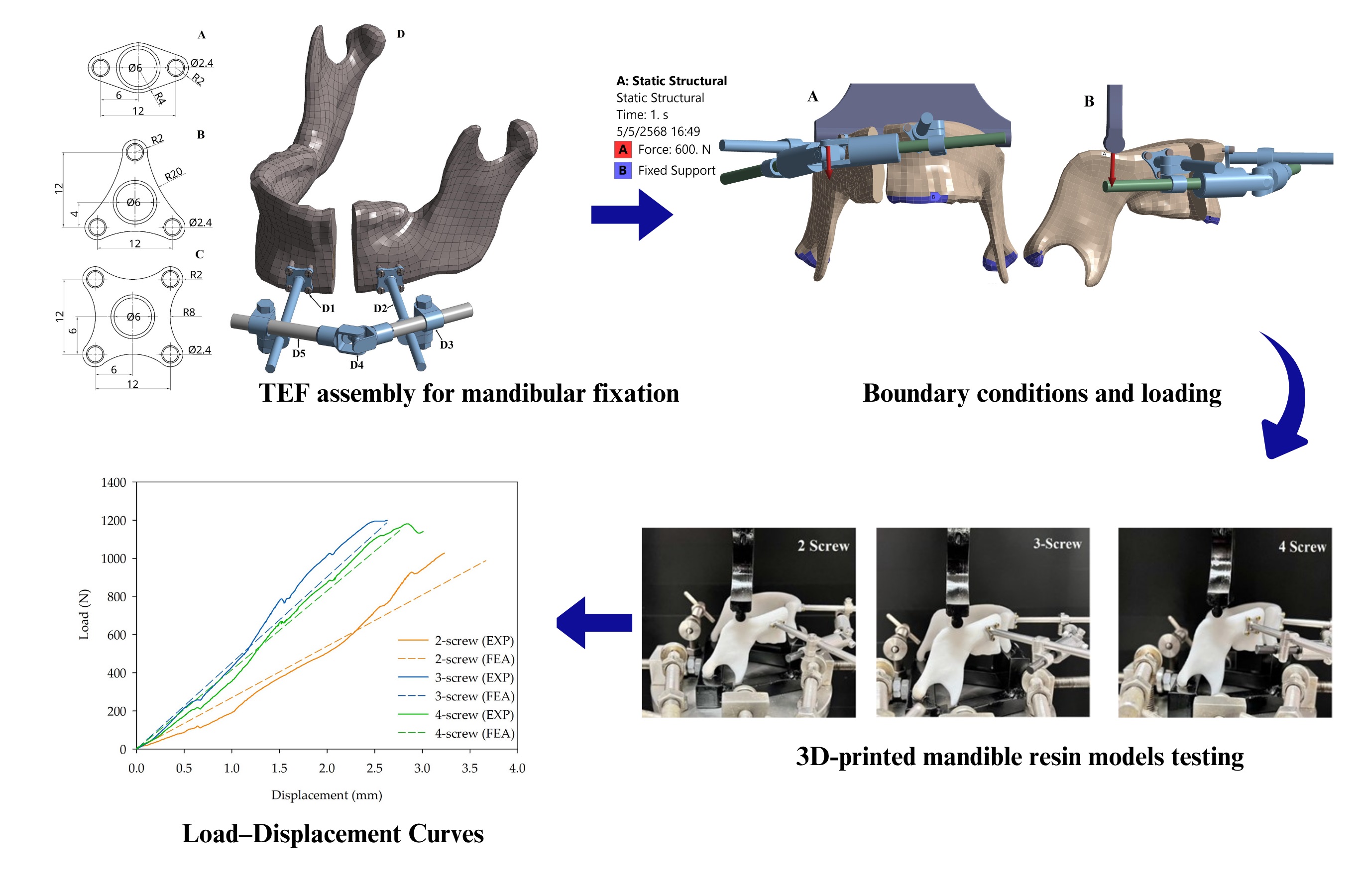
Mandibular reconstruction after tumor resection requires stable fixation that restores function and facial symmetry while minimizing invasiveness. This study presents and validates a bicortical screw–plate Temporary External Fixator (TEF) designed to enhance early-stage mandibular stabilization through optimized geometric configuration. An integrated approach combining finite element analysis (FEA) and experimental compression testing was employed to evaluate biomechanical performance under physiologically representative masticatory loads. Finite-element models of three TEF configurations (2-, 3-, and 4-screw) were analyzed using isotropic and anisotropic bone properties. Loads were applied as a static 600 N and a cyclic half-sine waveform. The 3-screw configuration exhibited the highest stiffness of 272.7 N/mm, lower peak cortical stress (26.49 MPa), and energy absorption of 0.96 J. The experimental tests on 3D-printed resin mandibles closely matched the FEA predictions , with displacement deviations below 5%, confirming the model’s predictive reliability. The results highlighted that strategic screw placement and spacing had a larger impact on biomechanical performance than screw count alone. The proposed TEF demonstrated favorable structural efficiency, procedural simplicity, and cost-effectiveness. The computational-experimental framework established in this work supports future patient-specific optimization and fatigue-life studies for the development of next-generation external fixators in mandibular reconstruction.
Biomechanical performance; Finite element analysis; Mandibular reconstruction; Screw-Plate system; Temporary external fixator
| Filename | Description |
|---|---|
| R2-IE-7849-20251028164529.jpg | Fig 1 |
| R2-IE-7849-20251028164605.jpg | Fig2 |
| R2-IE-7849-20251028164633.jpg | Fig3 |
| R2-IE-7849-20251028164703.jpg | Fig4 |
| R2-IE-7849-20251028164718.jpg | Fig5 |
| R2-IE-7849-20251028164733.jpg | Fig6 |
| R2-IE-7849-20251028164749.jpg | Fig7 |
| R2-IE-7849-20251028165325.jpg | Fig8 |
Ahmad,
M., Zulkifli, N., Shuib, S., Sulaiman, S., & Abdullah, H. (2020). Finite
Element Analysis of Proximal Cement Fixation in Total Hip Arthroplasty.
International Journal of Technology, 11, 1046. https://doi.org/10.14716/ijtech.v11i5.4318
Ahmad
Kholil, G. K. A. A. F. J. I. (2023). Finite Element Analysis of Lattice
Structure Model with Control Volume Manufactured Using Additive Manufacturing.
International Journal of Technology, 14(7), 291–319. https://doi.org/10.14716/ijtech.v14i7.6660
Alencar, M. G. M. d., Bortoli, M. M. D.,
Silva, T. C. G. d., Silva, E. D. d. O. e., & Laureano Filho, J. R. (2018). Suitability
of Wrist External Fixator for Treatment of Mandibular Fracture. Journal of
Craniofacial Surgery, 29(4), e371–e372. https://doi.org/10.1097/scs.0000000000004375
ANSYS
Inc. (2021). ANSYS Workbench
(Computer software; Version 21.0).
Bazyar, P., Baumgart, A., Altenbach, H., & Usbeck, A. (2023). An
Overview of Selected Material Properties in Finite Element Modeling of the
Human Femur. Biomechanics, 3(1), 124135. https://doi.org/10.3390/biomechanics3010012
Bobinskas, A. M., Subramaniam, S. S.,
Vujcich, N. J., & Nastri, A. L. (2016). Bilateral distraction
osteogenesis of vascularized iliac crest free flaps used in mandibular
reconstruction. Plastic and Reconstructive Surgery–Global Open, 4(3), e635. https://doi.org/10.1097/GOX.0000000000000623
Bujtar,
P., S´andor, G. K., Bojtos, A., Sz?ucs, A., & Barab´as, J. (2010). Finite
element analysis of the human mandible at 3 different stages of life. Oral
Surgery, Oral Medicine, Oral Pathology, Oral Radiology, and Endodontology,
110(3), 301–309. https://doi.org/10.1016/j.tripleo.2010.01.025
Chaiyachet, R., Boonma, A., &
Paipongna, T. (2024). Developing A Temporary External Fixator (TEF) For
Mandibular Reconstruction Using Two-Phase QFD And TRIZ Approach. Sains Malaysiana, 53(5), 1201–1218. https://doi.org/10.17576/jsm-2024-5305-17
Chaiyachet, R., Piyasin, S., Jina, W.,
Paipongna, T., & Boonma, A. (2025). Finite Element Analysis of a
Novel Temporary External Fixator (TEF) in Mandibular Reconstruction. Journal of
Applied Science and Engineering, 28(11), 2113–2125.
https://doi.org/10.6180/jase.202511\ 28(11).0003
Chen, A. C.-Y., Lin, Y.-H., Kuo, H.-N.,
Yu, T.-C., Sun, M.-T., & Lin, C.-L. (2013). Design optimisation and
experimental evaluation of dorsal double plating fixation for distal radius
fracture. Injury, 44(4), 527–534. https://doi.org/10.1016/j.injury.2012.09.022
Dassault
Syst`emes. (2020). SolidWorks
(Computer software; Version 2020).
Ellis III, E., & Graham, J. (2002). Use
of a 2.0-mm locking plate/screw system for mandibular fracture surgery. Journal
of oral and maxillofacial surgery, 60(6), 642–645. https://doi.org/10.1053/joms.2002.33110
Formlabs.
(2024). White Resin V4 (FLGPWH04) Technical Data Sheet [Retrieved May 20]. https://formlabs.com/materials/engineering/white-resin/
Ganser,
A., Thompson, R. E., Tami, I., Neuhoff, D., Steiner, A., & Ito, K. (2007).
An in Vivo Experimental Comparison of Stainless Steel and Titanium Schanz
Screws for External Fixation. European Journal of Trauma and Emergency Surgery,
33(1), 59–68. https://doi.org/10.1007/s00068-007-6053-5
Govoni, F. A., Felici, N., Ornelli, M.,
Marcelli, V. A., Migliano, E., Pesucci, B. A., & Pistilli, R. (2023). Total
mandible and bilateral TMJ reconstruction combining a customized jaw implant
with a free fibular flap: a case report and literature review. Maxillofacial
Plastic and Reconstructive Surgery, 45(1), 6. https://doi.org/10.1186/s40902-023-00374-w
Gutwald,
R., Jaeger, R., & Lambers, F. M. (2017). Customized mandibular
reconstruction plates improve mechanical performance in a mandibular
reconstruction model. Computer methods in biomechanics and biomedical
engineering, 20(4), 426–435. https://doi.org/10.1080/10255842.2016.1240788
Hemathulin,
S., Nualsing, D., Pannucharoenwong, N., Nabudda, K., Paholpak, P., Echaroj, S.,
&Kongthip, P. (2024). Comparison of Treatment Positions for Tibia Fractures
using the External Narrow Locking Compression Plate: 3D Finite Element
Analysis. Engineered Science. https://doi.org/10.30919/es1300
Izra’ai, S. I., Abdullah, A. H., Saari, A.
B., Kasim, H. A., Hazwani, F., & Marwan, S. H. (2025). Computational
Evaluation of Dental Adhesive for Four Direct Restorative Procedures.
International Journal of Online & Biomedical Engineering, 21(3), 183–190. https://doi.org/10.3991/ijoe.v21i03.54099
Jaber,
M., Abouseif, N., Ibrahim, N., Hassan, M., & El-Ameen, A. M. (2023).
Reasons for removal of miniplates used in fixation of maxillofacial bone
fractures: systematic review and meta-analysis. Applied Sciences, 13(21),
11899. https://doi.org/10.3390/app132111899
Jia, Y.-F., Xuan, F.-Z., Chen, X., &
Yang, F. (2014). Finite element analysis of the cyclic indentation of
bilayer enamel. Journal of Physics D: Applied Physics, 47, 175401. https://doi.org/10.1088/0022-3727/47/17/175401
Kano,
S. C., Binon, P. P., Bonfante, G., & Curtis, D. A. (2007). The effect of
casting procedures on rotational misfit in castable abutments. International
Journal of Oral & Maxillofacial Implants, 22(4). International Journal of
Technology 16(6) 1-16 (2025) 15
Keddar,
I., Aour, B., & Zahaf, S. (2022). Comparative Study of the Fractured
Humerus Fixation by Intramedullary Nailing and Compression Plate. Journal of
Failure Analysis and Prevention, 22. https://doi.org/10.1007/s11668-022-01459-w
Koper,
D. C., Leung, C. A., Smeets, L. C., Laeven, P. F., Tuijthof, G. J., &
Kessler, P. A. (2021). Topology optimization of a mandibular reconstruction
plate and biomechanical validation. Journal of the mechanical behavior of
biomedical materials, 113, 104157. https://doi.org/10.1016/j.jmbbm.2020.104157
Lewis, G. S., Mischler, D., Wee, H., Reid,
J. S., & Varga, P. (2021). Finite element analysis of fracture
fixation. Current osteoporosis reports, 19(4), 403–416. https://doi.org/10.1007/s11914-021-00690-y
Liu, K., Abulaiti, A., Liu, Y., Cai, F.,
Ren, P., & Yusufu, A. (2021). Risk factors of pin tract infection
during bone transport using unilateral external fixator in the treatment of
bone defects. BMC Surgery, 21(1), 377. https://doi.org/10.1186/s12893-021-01384-z
Liu, Y., Wang, P., Telha, W., Jiang, N.,
Bi, R., & Zhu, S. (2024). Arthroscopic reduction and rigid fixation
of the anteriorly displaced temporomandibular joint disc without reduction
using titanium screw: a case series. Clinical Oral Investigations, 28(2), 156. https://doi.org/10.1007/s00784-024-05552-2
Materialise.
(2021). Mimics Research (Computer software; Version 21.0).
MatWeb.
(2024). Information on www.matweb.com
[Retrieved May 20]. https://www.matweb.com
Michael, L., Brian, S., Natalia von, W.,
Kyle, V., Nolan, S., & Matthew, O. (2022). Review of cost and
surgical time implications using virtual patient specific planning and patient
specific implants in midface reconstruction. Plastic and Aesthetic Research, 9,
26. https://doi.org/10.20517/2347-9264.2021.108
Narra,
N., Val´a?sek, J., Hannula, M., Marci´an, P., S´andor, G., Hyttinen, J., &
Wolff, J. (2013). Finite element analysis of customized reconstruction plates
for mandibular continuity defect therapy. Journal of biomechanics, 47. https://doi.org/10.1016/j.jbiomech.2013.11.016
Pankaj,
P. (2022). Devices for traumatology: biomechanics and design. In Human
orthopaedic biomechanics (pp. 459–484). Elsevier. https://doi.org/10.1016/B978-0-12-8244814.00033-0
Prasadh,
S., Krishnan, A. V., Lim, C., Gupta, M., & Wong, R. (2022). Titanium versus
magnesium plates for unilateral mandibular angle fracture fixation:
Biomechanical evaluation using 3-dimensional finite element analysis. Journal
of Materials Research and Technology, 18, 2064–2076. https://doi.org/10.1016/j.jmrt.2022.02.025
Sagl, B., Schmid-Schwap, M., Piehslinger,
E., Kundi, M., & Stavness, I. (2019). A dynamic jaw model with a
finite-element temporomandibular joint. Frontiers in Physiology, 10, 1156. https://doi.org/10.3389/fphys.2019.01156
Schonegg, D., M¨uller, G. T., Blumer, M.,
Essig, H., & Wagner, M. E. (2022). Two-versus three screw
osteosynthesis of the mandibular condylar head: a finite element analysis.
Journal of the mechanical behavior of biomedical materials, 127, 105077. https://doi.org/10.1016/j.jmbbm.2022.105077
Shi,
Q., Sun, Y., Yang, S., Van Dessel, J., L¨ubbers, H.-T., Zhong, S., Gu, Y.,
Bila, M., Dormaar, T., & Schoenaers, J. (2021). Failure analysis of an
in-vivo fractured patient-specific Ti6Al4V mandible reconstruction plate
fabricated by selective laser melting. Engineering Failure Analysis, 124,
105353. https://doi.org/10.1016/j.engfailanal.2021.105353
Smolka,
W., Cornelius, C.-P., & Mast, G. (2016). Survival rates after surgical
salvage procedures using mandible external pin fixation. Oral Surgery, 9(1),
19–24. https://doi.org/10.1111/ors.12163
Sood, R., Ramu, J., Thankappan, K., &
Iyer, S. (2021). Reconstruction of the Mandible and Choice of Flap. In
Management of oral cancers (pp. 195–210). Springer. https://doi.org/10.1007/978-981-15-6499-4\_15
Suojanen, J., Leikola, J., & Stoor, P.
(2017). The use of patient-specific implants in orthognathic surgery: A
series of 30 mandible sagittal split osteotomy patients. Journal of Cranio
Maxillofacial Surgery, 45(6), 990–994. https://doi.org/10.1016/j.jcms.2017.02.021
Tumer, D., Gungorurler, M., Hav?tc?oglu,
H., & Arman, Y. (2020). Investigation of effective coating of the
Ti–6Al–4V alloy and 316L stainless steel with graphene or carbon nanotubes with
finite element methods. Journal of Materials Research and Technology, 9(6),
15880–15893. https://doi.org/10.1016/j.jmrt.2020.11.052
Wang,
J., Rai, R., & Armstrong, J. N. (2020). Investigation of compressive
deformation behaviors of cubic periodic cellular structural cubes through 3D
printed parts and FE simulations. Rapid Prototyping Journal, 26(3), 459–472. https://doi.org/10.1108/RPJ-03-2019-0069
Wang,
M. C., Kiapour, A., Massaad, E., Shin, J. H., & Yoganandan, N. (2023). A
guide to finite element analysis models of the spine for clinicians. Journal of
Neurosurgery: Spine, 40(1), 38–44. https://doi.org/10.3171/2023.7.SPINE23164
Wilken, A., Schultz, J., Luo, Z.-X., &
Ross, C. (2024). A new biomechanical model of the mammal jaw based on
load path analysis. The Journal of experimental biology, 227. https://doi.org/10.1242/jeb.247030
Zheng, F., Yunfan, Z., Gong, Y., Yin, D., & Liu, Y. (2022). Variation in stress distribution modified by mandibular material property: a 3D finite element analysis. Computer Methods and Programs in Biomedicine, 229, 107310. https://doi.org/10.1016/j.cmpb.2022.107310
Zhou, F., Yang, S., Liu, J., Lu, J., Shang, D., Chen, C., Wang, H., & Ma, J. (2020). Finite element analysis comparing short-segment instrumentation with conventional pedicle screws and the Schanz pedicle screw in lumbar 1 fractures. Neurosurgical Review, 43, 301–312. https://doi.org/10.1007/s10143-019-01146-9