
Synergy-Based Multi-Domain Risk Integration for Critical E-Government Infrastructure: The MuSyRI Framework and Policy Implications
Published at : 01 Dec 2025
Volume : IJtech
Vol 16, No 6 (2025)
DOI : https://doi.org/10.14716/ijtech.v16i6.7815
| Yuri Chernenko | Department of Doctoral Studies, International University of Business and Law |
| Olena Borodina | Faculty of Management, Public Administration and Marketing, Kyiv University of Market Relations |
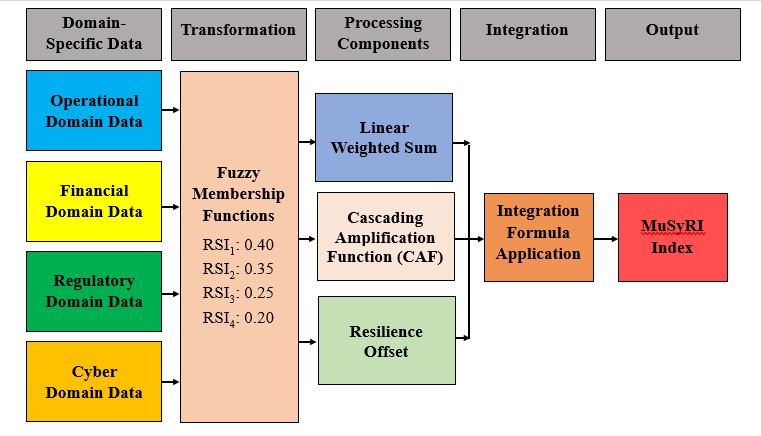
This study aims to develop and validate the MuSyRI early-warning index for critical e-government infrastructure. This study introduces the Multi-Domain Synergistic Resilience Index (MuSyRI), a bounded [0–1] metric that identifies nonlinear, compound risks across operational, financial, regulatory, and cyber domains in critical e-government infrastructure. MuSyRI explicitly integrates domain-specific resilience factors to modulate synergy-driven escalation. A multiple-case study of four anonymised organizations – a housing-services agency, a specialized construction firm, a water-tech startup, and a partially state-owned energy – water utility – validates MuSyRI. ERP-BPMS logs are converted into fuzzy sub-indices and aggregated via a Cascading Amplification Function (CAF) to capture concurrent moderate hazards and offset by a resilience term. Parameters were calibrated using Delphi panels, genetic algorithms, and expert elicitation. MuSyRI detects overlapping medium-level risks 1–4 weeks earlier than standard additive approaches. Early synergy alerts enabled proactive interventions, reducing housing-service disruptions by 8%–12% and boosting pilot adoption in the water-tech case by 12%–15%. Resilience offset curtails overestimation and preserves policymakers’ and managers’ interpretability. Unlike linear or unbounded fuzzy methods, MuSyRI formally integrates a nonlinear synergy function with domain-specific resilience into one bounded index. Consequently, it offers an actionable early warning framework for multi-domain oversight, resource prioritization, and digital governance reforms in e-government ecosystems.
Critical infrastructure; E-government; Multi-domain risk; MuSyRI; Synergy-based index
Akbari Ahmadabadi,
A., & Heravi, G. (2019). Risk assessment framework of ppp-megaprojects
focusing on risk interaction and project success. Transportation Research Part
A: Policy and Practice, 124, 169–188. https://doi.org/10.1016/j.tra.2019.03.011
Arvidsson, B., Johansson, J., & Guld?aker, N. (2021).
Critical infrastructure, geographical information science and risk governance:
A systematic cross-field review. Reliability Engineering and System Safety,
213, 107741. https://doi.org/10.1016/j.ress.2021.107741
Beckers, F., & Stegemann, U. (2013). A risk-management
approach to a successful infrastructure project [Viewed 14 May 2025]. https://www.mckinsey.com/business-functions/operations/our-insights/a-risk-management-approach-to-a-successful-infrastructure-project
Bentahar, A., & Rifai, A. (2022). Risk and risk
management in the public sector: A theoretical contribution. Journal of
Economics, Finance and Management Studies, 5(9), 2492–2506. https://doi.org/10.47191/jefms/v5-i9-03
Berawi, M., Leviakangas, P., Muhammad, F., Sari, M.,
Gunawan, Yatmo, Y., & Suryanegara, M. (2019). Optimizing search and rescue
personnel allocation in disaster emergency response using fuzzy logic.
International Journal of Technology, 10(7), 1416. https://doi.org/10.14716/ijtech.v10i7.3709
Boni, M., Faiella, A., Gazzola, V., & Pergalani, F.
(2025). A multi-hazard and multi-risk assessment methodological approach to
support civil protection planning in wide areas. International Journal of
Disaster Risk Reduction, 119, 105343. https://doi.org/10.1016/j.ijdrr.2025.105343
Božovic, M., Mihajlovic, E., & Zivkovic, S. (2020).
Risk management in the context of multi-risk assessment. Facta Universitatis,
Series: Working and Living Environmental Protection, 161(3), 161–169. https://doi.org/10.22190/FUWLEP1903161B
Cai, B., Xie, M., Liu, Y., Liu, Y., Ji, R., & Feng, Q.
(2017). A novel critical infrastructure resilience assessment approach using
dynamic Bayesian networks. AIP Conference Proceedings, 1890(1), 040043. https://doi.org/10.1063/1.5005245
Carpignano, A., Grosso, D., Gerboni, R., & Bologna, A.
(2021). Resilience of critical infrastructures: A risk assessment methodology
for energy corridors. In V. Rosato & A. Di Pietro (Eds.), Issues on Risk
Analysis for Critical Infrastructure Protection. IntechOpen. https://doi.org/10.5772/intechopen.94755
Chang, J., Yin, Z., Zhang, Z., Xu, X., & Zhao, M.
(2023). Multi-disaster integrated risk assessment in city range—a case study of
Jinan, China. International Journal of Environmental Research and Public
Health, 20(4), 3483. https://doi.org/10.3390/ijerph20043483
Dudauri, T. (2022). Peculiarities of integrated risk
management. Economics, 105(6–8), 112–123. https://doi.org/10.36962/ecs/105/6-8/2022-112
Falco, G., Noriega, A., & Susskind, L. (2019). Cyber
negotiation: A cyber risk management approach to defend urban critical
infrastructure from cyberattacks. Journal of Cyber Policy, 4(1), 90–116. https://doi.org/10.1080/23738871.2019.1586969
Farrington, S. (2016). Enterprise risk management powers up
at utilities [Viewed 14 May 2025]. https://www.risk.net/commodities/energy/2473744/enterprise-risk-management-powers-utilities
Gopalakrishnan, S., & Sankaranarayanan, S. (2023).
Cooperative security against interdependent risks. Production and Operations
Management, 32(11), 3504–3520. https://doi.org/10.1111/poms.14047
Hallegatte, S., Rentschler, J., & Rozenberg, J. (2019).
Lifelines: The resilient infrastructure opportunity. World Bank Group. https://doi.org/10.1596/978-1-4648-1430-3
Hendra, F., Mohammad, R., Amrin, A., Maarop, N., &
Zagloel, T. (2024). Systematic literature review of risk assessment techniques,
standard and guidelines for railway. International Journal of Technology,
15(4), 1148. https://doi.org/10.14716/ijtech.v15i4.6384
Hochrainer-Stigler, S., Trogrli? Saki?, R., Reiter, K.,
Ward, P., De Ruiter, M., Duncan, M. J., … Gottardo, S. (2023). Toward a
framework for systemic multi-hazard and multi-risk assessment and management.
iScience, 26(5), 106736. https://doi.org/10.1016/j.isci.2023.106736
Jandhana, I., & Agustini, H. (2024). Performance
evaluation of the industrial resilience index by using cross-correlation
method. International Journal of Technology, 15(5), 1462. https://doi.org/10.14716/ijtech.v15i5.5599
Jandhana, I., Nurcahyo, R., & Zagloel, T. (2018).
Resilient structure assessment using cobb-douglas production function: The case
of the Indonesian metal industry. International Journal of Technology, 9(5),
1061. https://doi.org/10.14716/ijtech.v9i5.1862
Jiwei, L., Kang, T., Kong, R., & Soon, S. (2019).
Modelling critical infrastructure network interdependencies and failure.
International Journal of Critical Infrastructures, 15(1), 1–23. https://doi.org/10.1504/IJCIS.2019.096557
Kelic, A. (2019). Cyber risk in critical infrastructure.
ACM SIGMETRICS Performance Evaluation Review, 46(2), 72–75. https://doi.org/10.1145/3305218.3305243
Labaka, L., Hernantes, J., & Sarriegi, J. (2016). A
holistic framework for building critical infrastructure resilience.
Technological Forecasting and Social Change, 103, 21–33. https://doi.org/10.1016/j.techfore.2015.11.005
Larsson, A., & Große, C. (2023). Data use and data
needs in critical infrastructure risk analysis. Journal of Risk Research, 26(5),
524–546. https://doi.org/10.1080/13669877.2023.2181858
Lin, J., & Pan, T.-C. (2022). Modelling of
multi-sectoral critical infrastructure interdependencies for vulnerability
analysis. Disaster Prevention and Resilience, 1, 2. https://doi.org/10.20517/dpr.2021.05
Mahama, H., Elbashir, M., Sutton, S., & Arnold, V.
(2022). Enabling enterprise risk management maturity in public sector
organisations. Public Money and Management, 42(6), 403–407. https://doi.org/10.1080/09540962.2020.1769314
Menoni, S., Galderisi, A., Carrion, D., & Gerosa, C.
(2024). Cross-sectoral and multilevel dimensions of risk and resilience
management in urban areas enabled by geospatial data processing.
Sustainability, 16(19), 8712. https://doi.org/10.3390/su16198712
Mohebbi, S., Zhang, Q., Wells, E. C., Zhao, T., Nguyen, H.,
Li, M., … Ou, X. (2020). Cyber-physical-social interdependencies and
organisational resilience: A review of water, transportation, and cyber
infrastructure systems and processes. Sustainable Cities and Society, 62,
102327. https://doi.org/10.1016/j.scs.2020.102327
Moussa, A., Ezzeldin, M., & El-Dakhakhni, W. (2024).
Predicting and managing risk interactions and systemic risks in infrastructure
projects using machine learning. Automation in Construction, 168, 105836. https://doi.org/10.1016/j.autcon.2024.105836
Murasov, R., Nikitin, A., & Meshcheriakov, I. (2024).
Mathematical model of risk assessment of the operation of critical
infrastructure objects based on the theory of fuzzy logic. Social Development
and Security, 14(5), 166–174. https://doi.org/10.33445/sds.2024.14.5.17
National Infrastructure Advisory Council (NIAC). (2010). A
framework for establishing critical infrastructure resilience goals: Final
report and recommendations (Tech. rep.). U.S. DHS. https://www.cisa.gov/sites/default/files/publications/niac-critical-infrastructure-resilience-final-report-09-08-09-508.pdf
National Institute for Strategic Studies (NISS). (2021).
The state critical infrastructure protection system in the national security
and defense sector: Analytical report (English ed.). NISS. https://niss.gov.ua/sites/default/files/2021-02/english-version-cip-dopovid-1.pdf
National Institute of Standards and Technology. (2020).
NIST privacy framework: A tool for improving privacy through enterprise risk
management, version 1.0. https://doi.org/10.6028/NIST.CSWP.01162020
Nweke, L., & Wolthusen, S. (2021). A holistic approach
for enhancing critical infrastructure protection: Research agenda. In J.
Abawajy et al. (Eds.), International Conference on Emerging Applications and
Technologies for Industry 4.0, 220–228. https://doi.org/10.1007/978-3-030-80216-5_16
OECD. (2019). Good governance for critical infrastructure
resilience. https://doi.org/10.1787/02f0e5a0-en
Petit, F., Verner, D., Phillips, J., & Lewis, L.
(2018). Critical infrastructure protection and resilience – integrating
interdependencies. In A. Masys (Ed.), Security by Design, 193–219. https://doi.org/10.1007/978-3-319-78021-4_10
Prasetya, B., Tampubolon, B., & Yopi, Y. (2023). Role
of risk management and standardization for supporting innovation in new normal
based on lessons learned during pandemic COVID-19. International Journal of
Technology, 14(5), 954. https://doi.org/10.14716/ijtech.v14i5.5299
Rød, B., Lange, D., Theocharidou, M., & Pursiainen, C.
(2020). From risk management to resilience management in critical
infrastructure. Journal of Management in Engineering, 36(4). https://doi.org/10.1061/(ASCE)ME.1943-5479.0000795
Sakic Trogrlic, R., Ma, L., Torresan, S., Ciurean, R., …
Padron-Fumero, N. (2024). Challenges in assessing and managing multi-hazard
risks: A European stakeholders’ perspective. EGU General Assembly 2024, Abstract
EGU24-3843. https://doi.org/10.5194/egusphere-egu24-3843
Samanis, E., Gardiner, J., & Rashid, A. (2022).
Adaptive cyber security for critical infrastructure. 2022 ACM/IEEE 13th
International Conference on Cyber-Physical Systems (ICCPS), 304–305. https://doi.org/10.1109/ICCPS54341.2022.00043
Sambowo, A., & Hidayatno, A. (2021). Resilience index
development for the manufacturing industry based on robustness,
resourcefulness, redundancy, and rapidity. International Journal of Technology,
12(6), 1177. https://doi.org/10.14716/ijtech.v12i6.5229
Saruniene, I., Martišauskas, L., Krikštolaitis, R.,
Augutis, J., & Setola, R. (2024). Risk assessment of critical
infrastructures: A methodology based on criticality of infrastructure elements.
Reliability Engineering and System Safety, 243, 109797. https://doi.org/10.1016/j.ress.2023.109797
Schlosser, C., Frankenfeld, C., Eastham, S., Gao, X.,
Gurgel, A., McCluskey, A., Morris, J., Orzach, S., Rouge, K., Paltsev, S.,
& Reilly, J. (2023). Assessing compounding risks across multiple systems
and sectors: A socio-environmental systems risk-triage approach. Frontiers in
Climate, 5, 1–19. https://doi.org/10.3389/fclim.2023.1100600
Scolobig, A., Komendantova, N., & Mignan, A. (2017).
Mainstreaming multi-risk approaches into policy. Geosciences, 7 (4), 129. https://doi.org/10.3390/geosciences7040129
Theoharidou, M., Kotzanikolaou, P., & Gritzalis, D.
(2011). Risk assessment methodology for interdependent critical
infrastructures. International Journal of Risk Assessment and Management, 15
(2-3), 128–148. https://doi.org/10.1504/IJRAM.2011.042113
Trifunovi´c, D. (2020). Elements of critical infrastructure
resilience. National Security and the Future, 20 (1-2), 51–61. https://doi.org/10.37458/nstf.20.1-2.6
Uwe, B.-R., & Gerber, B. (2019). Smart cities and the
challenges of cross domain risk management: Considering interdependencies
between ict-security and natural hazards disruptions. Economics and Culture, 16
(2), 106–116. https://doi.org/10.2478/jec-2019-0026
Ward, P. (2022). Myriad-eu: Towards disaster risk
management pathways in multi-risk assessment [Conference Abstract, Presentation
ID: EGU22-9323]. EGU General Assembly 2022, EGU22–9323. https://doi.org/10.5194/egusphere-egu22-9323
Ward, P., Daniell, J., Duncan, M., Dunne, A., Hananel, C.,
Hochrainer-Stigler, S., Tijssen, A., Torresan, S., Ciurean, R., Gill, J.,
Sillmann, J., Couasnon, A., Koks, E., Padr´on-Fumero, N., Tatman, S., Tronstad
Lund, M., Adesiyun, A., Aerts, J. C. J. H., Alabaster, A.,. . . de Ruiter, M.
(2021). Invited perspectives: A research agenda towards disaster risk management
pathways in multi-(hazard-)risk assessment. Natural Hazards and Earth System
Sciences, 22 (4), 1487–1497. https://doi.org/10.5194/nhess-2021-326
Wells, E., Boden, M., Tseytlin, I., & Linkov, I.
(2022). Modeling critical infrastructure resilience under compounding threats:
A systematic literature review. Progress in Disaster Science, 15, 100244. https://doi.org/10.1016/j.pdisas.2022.100244
Woods, M. (2022). Risk management in the public sector.
Routledge. https://doi.org/10.4324/9781315208336-8
Yin, R. (2018). Case study research and applications:
Design and methods (6th). Sage Publications. Zhang, P., Zhang, Z.-J., &
Gong, D.-Q. (2025). A full domain decision model for robust risk control based
on minimum linkage space and copula bayesian networks. Reliability Engineering
and System Safety, 260, 111046. https://doi.org/10.1016/j.ress.2025.111046
Zhang, X. (2022). Understanding innovation policy
governance: A disaggregated approach. Review of Policy Research, 39 (3),
303–329. https://doi.org/10.1111/ropr.12456
Zogheib, C., & Mahetaji, K. (2024). Cross-domain
information integration in government: Hierarchies and responsibilities.
Proceedings of the Association for Information Science and Technology, 61 (1),
469–480. https://doi.org/10.1002/pra2.1043
Zuo, F., Zio, E., & Yuan, Y. (2022). Risk-response
strategy optimisation considering limited risk-related resource allocation and
scheduling. Journal of Construction Engineering and Management, 148 (11). https://doi.org/10.1061/(ASCE)CO.1943-7862.0002392