
A Smart RFID-Driven System for Dementia Patient Tracking: A Machine Learning Approach for Monitoring and Localization
Corresponding email: m.deriche@ajman.ac.ae
Published at : 01 Dec 2025
Volume : IJtech
Vol 16, No 6 (2025)
DOI : https://doi.org/10.14716/ijtech.v16i6.7791
Raed, MW., Deriche, M., Rais, R., Ammar, K., & Nasor, M. (2025). A smart rfid-driven system for dementia patient tracking: A machine learning approach for monitoring and localization. International Journal of Technology, 16 (6), 2101–2121.
| Mhd Wasim Raed | Department of Computer Engineering, Istanbul Aydin University, Istanbul, Turkey |
| Mohamed Deriche | College of Engineering and Information Technology, Ajman University, Ajman, UAE |
| Rao Bin Rais | College of Engineering and Information Technology, Ajman University, Ajman, UAE |
| Khalid Ammar | College of Engineering and Information Technology, Ajman University, Ajman, UAE |
| Mohamed Nasor | College of Engineering and Information Technology, Ajman University, Ajman, UAE |
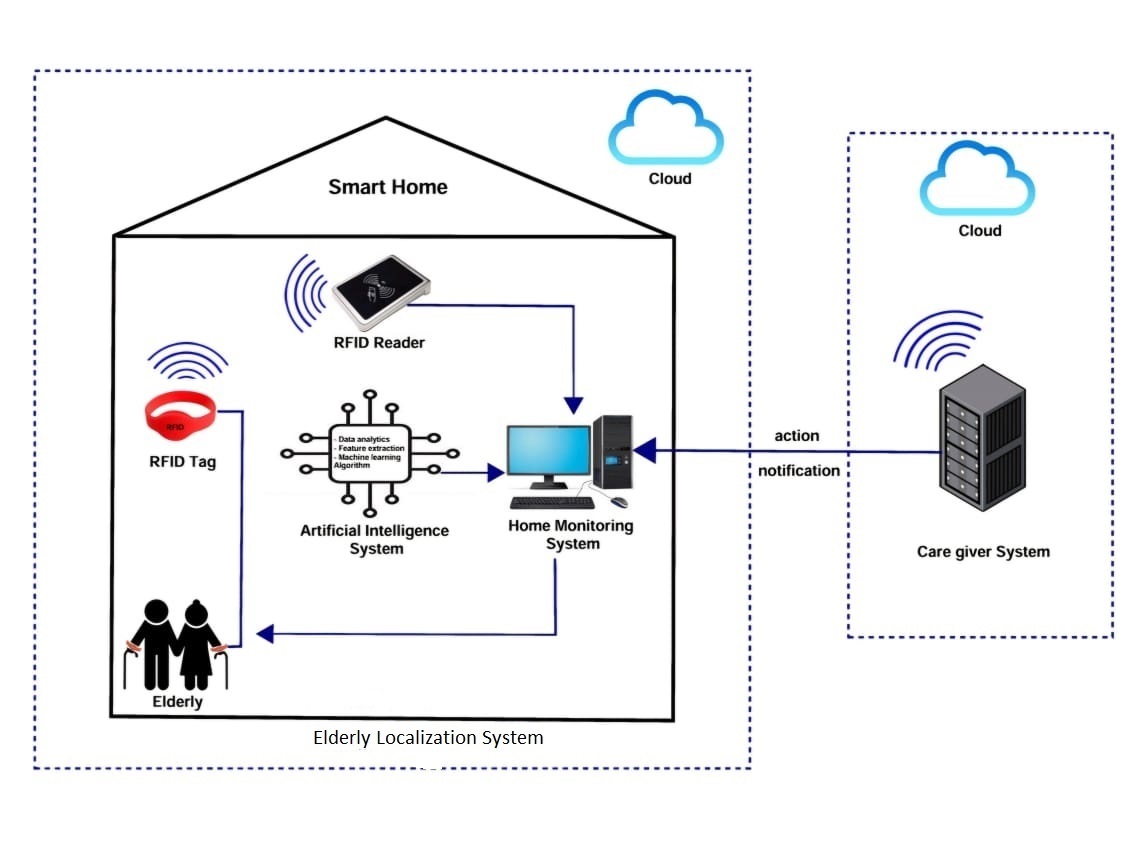
The global increase in the elderly population, which is expected to reach 2.1 billion by 2050, has highlighted the need for reliable monitoring systems to assist elderly individuals, especially those with dementia. More than 55 million people worldwide live with dementia, a disease liable to induce fatal incidents such as wandering off and falling, resulting in almost 30% of injury-related deaths in the elderly. Current technologies, including GPS and camera-based systems, face severe limitations in indoor environments, such as privacy intrusions, high costs, and dependence on line-of-sight visibility. This study introduces a novel, cost-effective radio frequency identification (RFID)-based tracking system optimized for indoor settings to address these gaps. Leveraging the Internet of Things (IoT) architecture and cloud computing, our solution employs battery-less RFID tags embedded in unobtrusive wearable devices (e.g., anklets or bracelets) to enable real-time, multi-individual tracking without compromising privacy or relying on external power. Our proposed system uniquely integrates the efficiency of a low-complexity, cost-effective fingerprint-based localization framework with real-time data analytics and optimized ML models to achieve the accuracy, affordability, and scalability required for smart home applications for dementia. Extensive evaluation in simulated smart home environments demonstrates a 98% localization accuracy with NN and a modified KNN algorithm, outperforming existing approaches. As a proof of concept, the developed RFID-based localization system is capable of accurately tracking multiple elderly individuals within the home setting. Overall, the proposed system showed excellent accuracy results with only off-the-shelf components. The proposed system addresses scalability and cost barriers, offering a robust alternative to the more expensive and often hard-to-use commercial systems. This developed system not only enhances the safety of patients with dementia but also establishes a robust, adaptable framework for future IoT-driven healthcare applications.
Dementia; Internet of Things; K-Nearest Neighbor (KNN); Radio Frequency Identification (RFID); Received Signal Strength Indicator (RSSI); Smart Home
Aldelemy, A., Oguntala, G., BinMelha, M. S., Ngala, M.,
& Abd-Alhameed, R. A. (2024). A comprehensive review of rf-based
localisation methods and their applications in healthcare. Proceedings of the
3rd International Multi-Disciplinary Conference: “Integrated Sciences and
Technologies”, IMDC-IST 2023, 25-27 October 2023, Yola, Nigeria. https://doi.org/10.4108/eai.25-10-2023.2348722
Alharbi, H., Alharbi, K., & Hassan, C. (2023).
Enhancing elderly fall detection through iot-enabled smart flooring and ai for independent
living sustainability. Sustainability, 15(22). https://doi.org/10.3390/su152215695
Alsinglawi, B., Elkhodr, M., Nguyen, Q. V., &
Gunawardana, U. (2017). Rfid localization for internet of things smart homes: A
survey. International Journal of Computer Networks and Communications, 9(1),
81–99. https://doi.org/10.5121/ijcnc.2017.9107
Alvarez-Narciandi, G., Motroni, A., Rodriguez Pino, M.,
Buffi, A., & Nepa, P. (2019). A uhf-rfid gate control system based on a
recurrent neural network. IEEE Antennas and Wireless Propagation Letters,
18(11), 2330–2334. https://doi.org/10.1109/LAWP.2019.2929416
Amin, A., & Deriche, M. (2016). Salt-dome detection
using a codebook-based learning model. IEEE Geoscience and Remote Sensing
Letters, 13(11), 1636–1640. https://doi.org/10.1109/LGRS.2016.2599435
Andò, B., Baglio, S., Crispino, R., & Marletta, V.
(2021). An introduction to indoor localization techniques. Case of study: A
multi-trilateration-based localization system with user–environment interaction
feature. Applied Sciences, 11(16). https://doi.org/10.3390/app11167392
Arakawa, T., Shiramatsu, S., & Iwata, A. (2018).
Wandering path visualization system prototype for finding wandering elderly
people using ble beacon. 2018 Sixth International Symposium on Computing and
Networking Workshops (CANDARW), 491–495. https://doi.org/10.1109/CANDARW.2018.00095
Azizan, A. (2024). Challenges and opportunities in
sensor-based fall prevention for older adults: A bibliometric review. Journal
of Enabling Technologies, 18(4), 306–318. https://doi.org/10.1108/JET-02-2024-0011
Berawi, M. (2023). Smart cities: Accelerating sustainable
development agenda. International Journal of Technology, 14(1), 1–4. https://doi.org/10.14716/ijtech.v14i1.6323
Berawi, M., Sari, M., Salsabila, A., Susantono, B., &
Woodhead, R. (2022). Utilizing building information modelling in the tax
assessment process of apartment buildings. International Journal of Technology,
13(7), 1515–1526. https://doi.org/10.14716/ijtech.v13i7.6188
Bibbò, L., Carotenuto, R., & Della Corte, F. (2022). An
overview of indoor localization system for human activity recognition (har) in
healthcare. Sensors, 22(21). https://doi.org/10.3390/s22218119
Bouchard, K., Fortin-Simard, D., Gaboury, S., Bouchard, B.,
& Bouzouane, A. (2014). Accurate trilateration for passive rfid
localization in smart homes. International Journal of Wireless Information
Networks, 21, 32–47. https://doi.org/10.1007/s10776-013-0234-4
Brena, R., García-Vázquez, J., Galván-Tejada, C., Muñoz-Rodriguez,
D., Vargas-Rosales, C., & J, F. (2017). Evolution of indoor positioning
technologies: A survey. Journal of Sensors, 2017(1), 2630413. https://doi.org/10.1155/2017/2630413
Buffi, A., Michel, A., Nepa, P., & Tellini, B. (2018).
Rssi measurements for rfid tag classification in smart storage systems. IEEE
Transactions on Instrumentation and Measurement, 67(4), 894–904. https://doi.org/10.1109/TIM.2018.2791238
Chen, W., Chen, L., Chang, W., & Tang, J. (2018). An
iot-based elderly behavioral difference warning system. 2018 IEEE International
Conference on Applied System Invention (ICASI), 308–309. https://doi.org/10.1109/ICASI.2018.8394594
Cheng, S., Wang, S., Guan, W., Xu, H., & Li, P. (2020).
3dlra: An rfid 3d indoor localization method based on deep learning. Sensors,
20(9). https://doi.org/10.3390/s20092731
Chin, C., Jian, T., Ee, L., & Leong, P. (2022).
Iot-based indoor and outdoor self-quarantine system for covid-19 patients.
International Journal of Technology, 13(6), 1231–1240. https://doi.org/10.14716/ijtech.v13i6.5844
Comai, S., Masciadri, A., Pozzi, G., & Salice, F.
(2025). Monitoring dressing autonomy: A remote home care rfid-based solution
for people with dementia. SN Computer Science, 6(454). https://doi.org/10.1007/s42979-025-03975-6
Dharani-Tejaswini, K., & Balasubramanian, V. (2018). A
scalable and hybrid location estimation algorithm for long-range rfid systems.
International Journal of Wireless Information Networks, 25, 186–199. https://doi.org/10.1007/s10776-018-0394-3
Du, C., Peng, B., Zhang, Z., Xue, W., & Guan, M.
(2020). Kf-knn: Low-cost and high-accurate fm-based indoor localization model
via fingerprint technology. IEEE Access, 8, 197523–197531. https://doi.org/10.1109/ACCESS.2020.3031089
Fang, C. (2018). Application for the geriatrics in
cognitive city: Prevention of lost patient with dementia. 2018 1st
International Cognitive Cities Conference (IC3), 28–31. https://doi.org/10.1109/IC3.2018.00016
Feng, X., Zhang, J., Chen, J., Wang, G., Zhang, L., &
Li, R. (2018). Design of intelligent bus positioning based on internet of
things for smart campus. IEEE Access, 6, 60005–60015. https://doi.org/10.1109/ACCESS.2018.2874083
Fu, Y., Chen, P., Yang, S., & Tang, J. (2018). An
indoor localization algorithm based on continuous feature scaling and outlier
deleting. IEEE Internet of Things Journal, 5(2), 1108–1115. https://doi.org/10.1109/JIOT.2018.2795615
Hendrarini, N., Asvial, M., & Sari, R. F. (2022).
Wireless sensor networks optimization with localization-based clustering using
game theory algorithm. International Journal of Technology, 13(1), 213–224. https://doi.org/10.14716/ijtech.v13i1.4850
Jiang, J. R., Subakti, H., & Liang, H. S. (2021).
Fingerprint feature extraction for indoor localization. Sensors, 21(16). https://doi.org/10.3390/s21165434
Kolakowski, M., & Blachucki, B. (2019). Monitoring
wandering behavior of persons suffering from dementia using ble based
localization system. 2019 27th Telecommunications Forum (TELFOR), 1–4. https://doi.org/10.1109/TELFOR48224.2019.8971136
Lau, X. L., Connie, T., Goh, M. K. O., & Lau, S. H.
(2022). Fall detection and motion analysis using visual approaches.
International Journal of Technology, 13(6), 1173–1182. https://doi.org/10.14716/ijtech.v13i6.5840
Li, A., Fu, J., Yang, A., & Shen, H. (2019). A new rss
fingerprinting-based location discovery method under sparse reference point
conditions. IEEE Access, 7, 13945–13959. https://doi.org/10.1109/ACCESS.2019.2893398
Li, S., Lu, J., & Chen, S. (2020). A room-level tag
trajectory recognition system based on multi-antenna rfid reader. Computer
Communications, 149, 350–355. https://doi.org/10.1016/j.comcom.2019.10.025
Luo, C., Cheng, L., Chan, M. C., Gu, Y., Li, J., &
Zhong, M. (2017). Pallas: Self-bootstrapping fine-grained passive indoor
localization using wifi monitors. IEEE Transactions on Mobile Computing, 16(2),
466–481. https://doi.org/10.1109/TMC.2016.2550452
Ma, Q., Li, X., Li, G., Ning, B., Bai, M., & Wang, X.
(2020). Mrliht: Mobile rfid-based localization for indoor human tracking.
Sensors, 20(6). https://doi.org/10.3390/s20061711
Merenda, M., Catarinucci, L., Colella, R., Iero, D., Della
Corte, F. G., & Carotenuto, R. (2022). Rfid-based indoor positioning using
edge machine learning. IEEE Journal of Radio Frequency Identification, 6,
573–582. https://doi.org/10.1109/JRFID.2022.3182819
Minne, K., Macoir, N., Rossey, J., Van Den Brande, Q.,
Lemey, S., Hoebeke, J., & De Poorter, E. (2019). Experimental evaluation of
uwb indoor positioning for indoor track cycling. Sensors, 19, 2041. https://doi.org/10.3390/s19092041
Molina, B., Olivares, E., Palau, C. E., & Esteve, M.
(2018). A multi-modal fingerprint-based indoor positioning system for airports.
IEEE Access, 6, 10092–10106. https://doi.org/10.1109/ACCESS.2018.2798918
Møller, M. F. (1993). A scaled conjugate gradient algorithm
for fast supervised learning. Neural Networks, 6(4), 525–533. https://doi.org/10.1016/S0893-6080(05)80056-5
Muangprathub, J., Sriwichian, A., Wanichsombat, A.,
Kajornkasirat, S., Nillaor, P., & Boonjing, V. (2021). A novel elderly
tracking system using machine learning to classify signals from mobile and
wearable sensors. International Journal of Environmental Research and Public
Health, 18(23), 12652. https://doi.org/10.3390/ijerph182312652
Naeim, M. K. M., Chung, G. C., Lee, I. E., Tiang, J. J.,
& Tan, S. F. (2023). A mobile iot-based elderly monitoring system for
senior safety. International Journal of Technology, 14(6), 1185–1195. https://doi.org/10.14716/ijtech.v14i6.6634
Nessa, A., Adhikari, B., Hussain, F., & Fernando, X. N.
(2020). A survey of machine learning for indoor positioning. IEEE Access, 8,
214945–214965. https://doi.org/10.1109/ACCESS.2020.3039271
Raad, M. W., Deriche, M., & Kanoun, O. (2021). An
rfid-based monitoring and localization system for dementia patients.
Multi-Conference on Systems, Signals and Devices (SSD). https://doi.org/10.1109/SSD52085.2021.9429375
Raad, M. W., Deriche, M., & Sheltami, T. (2021). An
iot-based school bus and vehicle tracking system using rfid technology and
mobile data networks. Arabian Journal for Science and Engineering, 46,
3087–3097. https://doi.org/10.1007/s13369-020-05111-3
Raad, M. W., Sheltami, T., Soliman, M. A., & Alrashed,
M. (2018). An rfid based activity of daily living for elderly with alzheimer’s.
Internet of Things (IoT) Technologies for HealthCare, HealthyIoT 2017, 54–61. https://doi.org/10.1007/978-3-319-76213-5_8
Rondon-Garcia, L. M., & Ramirez-Navarro, J. M. (2018).
The impact of quality of life on the health of older people from a
multi-dimensional perspective. Journal of Aging Research, 2018. https://doi.org/10.1155/2018/4086294
Rybenská, K., Knapová, L., Janis, K., K?hnová, J., Cimler,
R., & Elavsky, S. (2024). Smart technologies in older adult care: A scoping
review and guide for caregivers. Journal of Enabling Technologies. https://doi.org/10.1108/JET-05-2023-0016
Shahbazian, R., Macrina, G., Scalzo, E., & Guerriero,
F. (2023). Machine learning assists iot localization: A review of current
challenges and future trends. Sensors, 23(7), 3551. https://doi.org/10.3390/s23073551
Shit, R. C., Sharma, S., Puthal, D., James, P., Pradhan,
B., Moorsel, A. Y. Z., & Ranjan, R. (2019). Ubiquitous localization
(ubiloc): A survey and taxonomy on device free localization for smart world.
IEEE Communications Surveys and Tutorials, 21(4), 3532–3564. https://doi.org/10.1109/COMST.2019.2915923
Soro, B., & Lee, C. (2018). Performance comparison of
indoor fingerprinting techniques based on artificial neural network. IEEE
Region Conference (TENCON), 28–31. https://doi.org/10.1109/TENCON.2018.8650230
Soro, B., & Lee, C. (2019). Joint time-frequency rssi
features for convolutional neural network-based indoor fingerprinting
localization. IEEE Access, 7, 104892–104899. https://doi.org/10.1109/ACCESS.2019.2932469
Stark, S., Keglovits, M., Somerville, E., Hu, Y. L.,
Barker, A., Sykora, D., & Yan, Y. (2021). Home hazard removal to reduce
falls among community-dwelling older adults: A randomized clinical trial. JAMA
Network Open, 4(8), 2122044. https://doi.org/10.1001/jamanetworkopen.2021.22044
Suzuki, H., Kiyonobu, Y., Mogi, T., Matsushita, K., Hanada,
M., Suzuki, R., & Niijima, N. (2018). An updated watch-over system using an
iot device for elderly people living by themselves. 2018 3rd International
Conference on System Reliability and Safety (ICSRS), 115–119. https://doi.org/10.1109/ICSRS.2018.8688843
Tabbakha, N. E., Ooi, C. P., Tan, W. H., & Tan, Y. F.
(2021). A wearable device for machine learning based elderly’s activity
tracking and indoor location system. Bulletin of Electrical Engineering and
Informatics, 10(2), 927–939. https://doi.org/10.11591/eei.v10i2.2737
Taylor, M. E., Wesson, J., Sherrington, C., Hill, K. D.,
Kurrle, S., Lord, S. R., & Close, J. C. (2021). Tailored exercise and home
hazard reduction program for fall prevention in older people with cognitive
impairment: The i-focis randomized controlled trial. The Journals of
Gerontology: Series A, 76(4), 655–665. https://doi.org/10.1093/gerona/glaa241
Tegou, T., Kalamaras, I., Tsipouras, M., Giannakeas, N.,
Votis, K., & Tzovaras, D. (2019). A low-cost indoor activity monitoring
system for detecting frailty in older adults. Sensors, 19(3), 452. https://doi.org/10.3390/s19030452
Thakur, N., & Han, C. Y. (2021). Multimodal approaches
for indoor localization for ambient assisted living in smart homes.
Information, 12(3), 114. https://doi.org/10.3390/info12030114
Triapthi, A., Chakraborty, R., & Kopparapu, S. K.
(2021). Dementia classification using acoustic descriptors derived from
subsampled signals. 2020 28th European Signal Processing Conference (EUSIPCO),
91–95. https://doi.org/10.23919/Eusipco47968.2020.9287830
Varadharajan, V., Tupakula, U., & Karmakar, K. (2018).
Secure monitoring of patients with wandering behavior in hospital environments.
IEEE Access, 6, 11523–11533. https://doi.org/10.1109/ACCESS.2017.2773647
Wang, H., & Zheng, H. (2013). Model validation, machine
learning. In Encyclopedia of systems biology. Springer. https://doi.org/10.1007/978-1-4419-9863-7_233
Wasim-Raed, M., Huseyinov, I., Ozdemir, G., Kotenko, I.,
& Fedorchenko, E. (2023). An iot-based smart home for elderly suffering
from dementia. International Conference on Smart City Applications, 362–371. https://doi.org/10.1007/978-3-031-53824-7_33
Won, D., Park, M., & Chi, S. (2018). Construction
resource localization based on uav-rfid platform using machine learning algorithm.
International Conference on Industrial Engineering and Engineering Management
(IEEM), 1086–1090. https://doi.org/10.1109/IEEM.2018.8607668
Zhang, C., Qin, N., Xue, Y., & Yang, L. (2020).
Received signal strength-based indoor localization using hierarchical
classification. Sensors, 20(4), 1067. https://doi.org/10.3390/s20041067
Zhang, H., Zhang, Z., Gao, N., Xiao, Y., Meng, Z., &
Li, Z. (2020). Cost-effective wearable indoor localization and motion analysis
via the integration of uwb and imu. Sensors, 20(2), 344. https://doi.org/10.3390/s20020344
Zhang, X., Wong, A. K. S., Lea, C. T., & Cheng, R. S.
K. (2018). Unambiguous association of crowd-sourced radio maps to floor plans
for indoor localization. IEEE Transactions on Mobile Computing, 17(2), 488–502.
https://doi.org/10.1109/TMC.2017.2722413