
Design and Performance Analysis of Portable Vertical Burner Biomass Pellet for Green Tea Drying Process
Corresponding email: makbul.hajad@ugm.ac.id
Published at : 01 Dec 2025
Volume : IJtech
Vol 16, No 6 (2025)
DOI : https://doi.org/10.14716/ijtech.v16i6.7776
| Sugeng Harianto | Department of Agricultural and Biosystems Engineering, Faculty of Agricultural Technology, Universitas Gadjah Mada, Yogyakarta, 55281, Indonesia |
| Makbul Hajad | Department of Agricultural and Biosystems Engineering, Faculty of Agricultural Technology, Universitas Gadjah Mada, Yogyakarta, 55281, Indonesia |
| Bambang Purwantana | Department of Agricultural and Biosystems Engineering, Faculty of Agricultural Technology, Universitas Gadjah Mada, Yogyakarta, 55281, Indonesia |
| Joko Nugroho Wahyu Karyadi | Department of Agricultural and Biosystems Engineering, Faculty of Agricultural Technology, Universitas Gadjah Mada, Yogyakarta, 55281, Indonesia |
| Nina Amelia | Department of Agricultural and Biosystems Engineering, Faculty of Agricultural Technology, Universitas Gadjah Mada, Yogyakarta, 55281, Indonesia |
| Muhammad Akhsin Muflikhun | Department of Mechanical and Industrial Engineering, Faculty of Engineering, Universitas Gadjah Mada, Yo gyakarta, 55284, Indonesia |
| Suchada Rianmora | School of Manufacturing Systems and Mechanical Engineering, Sirindhorn International Institute of Technology, Thammasat University, Phatumthani, 12120, Thailand |
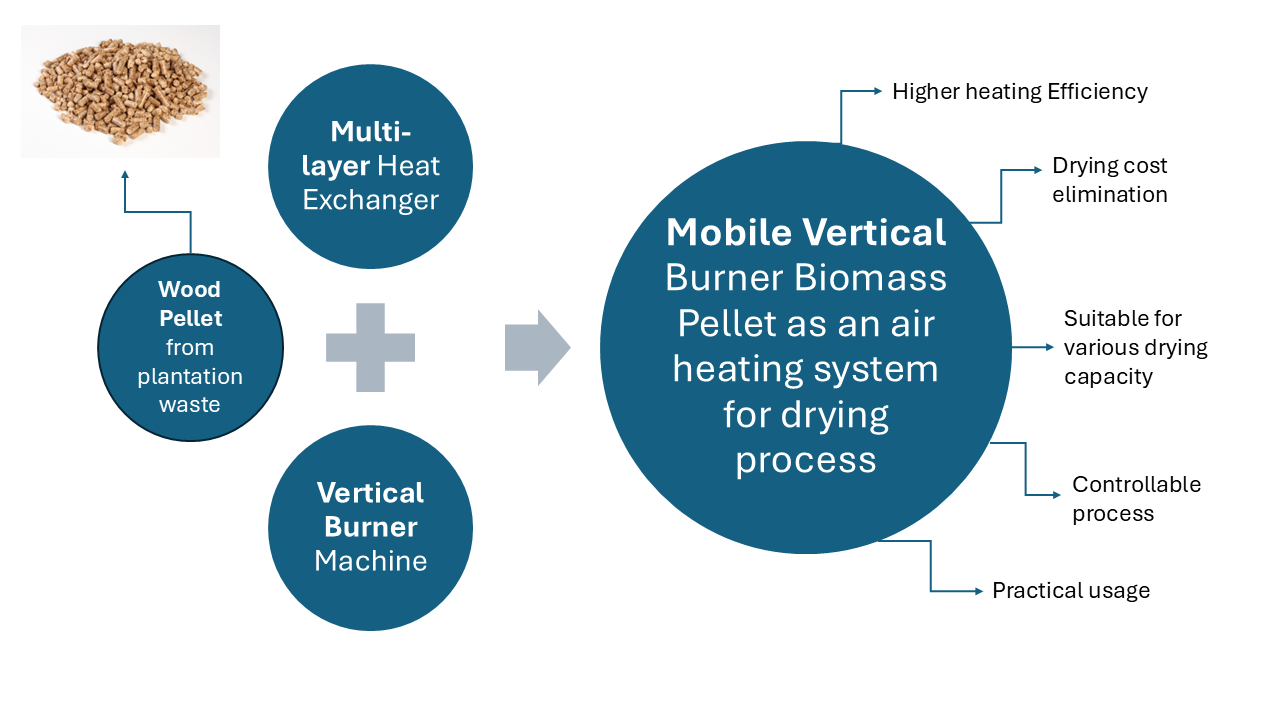
This study aimed to design a portable vertical biomass pellet burner as an alternativesolution to reduce energy costs in tea production, specifically for drying green tea using a ball tea dryer machine. The design combines a burner chamber unit with a multilayer heat exchanger to improve performance, and development was based on the drying air requirements of the process. The study used a Randomized Block Design (RBD) with two variables—feeding rate (5, 7, and 9 kg/h) and drying airflow (895.23, 1028.55, and 1103.47 CFM)—each tested at three levels.The performance was measured by the rate of temperature rise, drying air heating efficiency, and energy cost efficiency. The results showed that the burner design could meet the required airflow rate of up to 1150 CFM and reach temperatures of up to 120?C. To achieve the desired drying conditions, the optimal biomass pellet feeding rate was 7 kg/h, which costs approximately $0.09 per kilogram of dried tea—cheaper than using Liquid Petroleum Gas (LPG), which costs approximately $0.13/kg. The findings also revealed that both the airflow rate and feeding rate significantly affect the temperature increase rate and heating efficiency. Overall, this portable vertical biomass pellet burner can reduce green tea drying costs at ball tea drying stations by 30.28% compared with LPG usage.
Biomass pellet; Design improvement; Green tea drying; Performance analysis; Vertical burner
| Filename | Description |
|---|---|
| R3-ME-7776-20251107151827.pdf | --- |
Agbulut,
U., Gurel, A. E., & Bicen, Y. (2021). Prediction of daily global solar
radiation using different machine learning algorithms: Evaluation and
comparison. Renewable and Sustainable Energy Reviews, 135, 110–114. https://doi.org/https://doi.org/10.1016/j.rser.2020.110114
Ahn, J., & Jang, J. H. (2018). Combustion
characteristics of a 16 step grate-firing wood pellet boiler [1st International
Conference on Bioresource Technology for Bioenergy, Bioproducts Environmental
Sustainability]. Renewable Energy, 129, 678–685. https://doi.org/https://doi.org/10.1016/j.renene.2017.06.015
Al-attab,
K. A., & Zainal, Z. A. (2011). Design and performance of a pressurized
cyclone combustor (pcc) for high and low heating value gas combustion. Applied
Energy, 88(4), 1084–1095. https://doi.org/https://doi.org/10.1016/j.apenergy.2010.10.041
Alianto,
B., Rahim, G., Santoso, M., Nasruddin, N., & Nugroho, Y. (2025). Experiment
and modeling of smoke ventilation in a compartment using coconut husks as solid
fuels. International Journal of Technology, 16(2), 411–422. https://doi.org/https://doi.org/10.14716/ijtech.v16i2.6278
Alita,
D., Putra, A. D., & Darwis, D. (2021). Analysis of classic assumption test
and multiple linear regression coefficient test for employee structural office
recommendation. Indonesian Journal of Computing and Cybernetics Systems, 15(3),
295–306. https://doi.org/10.22146/ijccs.65586
Attanayake, D. D., Sewerin, F., Kulkarni,
S., Dernbecher, A., Alonso, A. D., & Van Wachem, B. (2023). Review
of modelling of pyrolysis processes with cfd-dem. Flow, Turbulence and
Combustion, 111, 355–408. https://doi.org/10.1007/s10494-023-00436-z
Balakheli,
M. M., Chahartaghi, M., Sheykhi, M., Hashemian, S. M., & Rafiee, N. (2020).
Analysis of different arrangements of combined cooling, heating and power
systems with internal combustion engine from energy, economic and environmental
viewpoints. Energy Conversion and Management, 203, 112253. https://doi.org/10.1016/j.enconman.2019.112253
Bardant,
T. B., Haq, M. S., Setiawan, A. A. R., Harianto, S., Waluyo, J., Mastur, A. I.,
Lestari, A. D., Sulaswatty, A., Sujarwo, S., Rinaldi, N., & Wiloso, E. I.
(2019). The renewability indicator and cumulative degree of perfection for
gamboeng tea; part 2, exergy calculation of tea factory. Jurnal Kimia Terapan Indonesia, 20(2), 79–89. https://doi.org/10.14203/jkti.v20i2.400
Buchner, D., Schraube, C., Carlon, E., von
Sonntag, J., Schwarz, M., Verma, V., & Ortwein, A. (2015). Survey of
modern pellet boilers in austria and germany: System design and customer
satisfaction of residential installations. Applied Energy, 160, 390–403. https://doi.org/10.1016/j.apenergy.2015.09.055
Burmawi,
B., Mulyanef, M., & Saputra, A. P. (2021). Analisa unjuk kerja dari heat
exchanger tipe shell and tube menggunakan air sebagai fluida panas dan fluida
dingin. Menara Ilmu, 15(1). https://doi.org/10.31869/mi.v15i1.2341
Carlon, E., Schwarz, M., Golicza, L.,
Verma, V. K., Prada, A., Baratieri, M., Haslinger, W., & Schmidl, C.
(2015). Efficiency and operational behaviour of small-scale pellet
boilers installed in residential buildings. Applied Energy, 155, 854–865. https://doi.org/10.1016/j.apenergy.2015.06.025
Chabane, F., Moummi, N., & Benramache,
S. (2013). Thermal efficiency analysis of a single-flow solar air heater
with different mass flow rates in a smooth plate. Frontiers in Heat and Mass
Transfer, 4(1). https://doi.org/10.5098/hmt.v4.1.3006
Chakraborty,
A., & Goswami, D. (2017). Prediction of slope stability using multiple
linear regression (mlr) and artificial neural network (ann). Arabian Journal of
Geosciences, 10(17). https://doi.org/10.1007/s12517-017-3167-x
Choi,
S. H., & Manousiouthakis, V. I. (2020). On the carbon cycle impact of
combustion of harvested plant biomass vs. fossil carbon resources. Computers
and Chemical Engineering, 140, 106942. https://doi.org/10.1016/j.compchemeng.2020.106942
Cifriadi,
A., Sugita, P., Wismogroho, A. S., Kemala, T., Nikmatin, S., Widayatno, W. B.,
Amal, M. I., Jayadi, F., Firdharini, C., & Kinasih, N. A. (2025).
Development and characterization of biomass-based biocarbon fillers for natural
rubber composites. International Journal of Technology, 16(3), 982–992. https://doi.org/10.14716/ijtech.v16i3.6809
Dale,
V. H., Kline, K. L., Parish, E. S., Cowie, A. L., Emory, R., Malmsheimer, R.
W., Slade, R., Smith, C. T., Wigley, T. B. B. E. N., Bentsen, N. S., Berndes,
G., Bernier, P., Brandao, M., Chum, H. L., Diaz-Chavez, R., Egnell, G.,
Gustavsson, L., Schweinle, J., Stupak, I., & Wellisch, M. (2017). Status
and prospects for renewable energy using wood pellets from the southeastern
united states. GCB Bioenergy, 9(8), 1296–1305. https://doi.org/10.1111/gcbb.12445
Deng,
M., Li, P., Shan, M., & Yang, X. (2020). Optimizing supply airflow and its
distribution between primary and secondary air in a forced-draft biomass pellet
stove. Environmental Research, 184, 109301. https://doi.org/10.1016/j.envres.2020.109301
Di-Giacomo, G., & Taglieri, L. (2009).
Renewable energy benefits with conversion of woody residues to pellets.
Energy, 34(5), 724–731. https://doi.org/10.1016/j.energy.2008.08.010
Enagi,
I. I., Al-attab, K. A., Zainal, Z. A., & Teoh, Y. H. (2022). Palm biodiesel
spray and combustion characteristics in a new micro gas turbine combustion
chamber design. Energy, 254, 124335. https://doi.org/10.1016/j.energy.2022.124335
Farokhi,
M., & Birouk, M. (2019). A hybrid edc/flamelet approach for modelling
biomass combustion of grate-firing furnace. Combustion Theory and Modelling,
23(4), 716–747. https://doi.org/10.1080/13647830.2019.1587177
Islam,
M. M., Wathore, R., Zerriffi, H., Marshall, J. D., Bailis, R., & Grieshop,
A. P. (2021). In-use emissions from biomass and lpg stoves measured during a
large, multi-year cookstove intervention study in rural india. Science of the
Total Environment, 758, 143698. https://doi.org/10.1016/j.scitotenv.2020.143698
Jandacka,
J., & Holubc?k, M. (2020). Emissions production from small heat sources
depending on various aspects. Mobile Networks and Applications, 25(3), 904–912.
https://doi.org/10.1007/s11036-020-01519-1
Johansson,
L. S., Leckner, B., Gustavsson, L., Cooper, D., Tullin, C., & Potter, A.
(2004). Emission characteristics of modern and old-type residential boilers
fired with wood logs and wood pellets. Atmospheric Environment, 38(25),
4183–4195. https://doi.org/10.1016/j.atmosenv.2004.04.020
Jolvis-Pou, K. R., Paul, S. K., &
Malakar, S. (2019). Industrial processing of ctc black tea. In
Caffeinated and cocoa based beverages (pp. 131–162). Woodhead Publishing. https://doi.org/10.1016/b978-0-12-815864-7.00004-0
Kayo,
C., Tojo, S., Iwaoka, M., & Matsumoto, T. (2014, December). Evaluation of
biomass production and utilization systems. CRC Press. https://doi.org/10.1016/B978-0-12-404609-2.00014-3
Klepacka,
A. M., & Florkowski, W. J. (2022). An opportunity for renewable energy:
Wood pellet use by rural households. In Handbook of climate change mitigation
and adaptation (pp. 1087–1120). Springer. https://doi.org/10.1007/978-3-030-72579-2_110
Kumar,
A., Alsadoon, A., Prasad, P. W. C., Abdullah, S., Rashid, T. A., Pham, D. T.
H., & Nguyen, T. Q. V. (2021). Generative adversarial network (gan) and
enhanced root mean square error (ermse): Deep learning for stock price movement
prediction. Multimedia Tools and Applications, 81(3), 3995–4013. https://doi.org/10.1007/s11042-021-11670-w
Kumar, K. R., Dashora, K., Kumar, S.,
Dharmaraja, S., Sanyal, S., Aditya, K., & Kumar, R. (2023). A review
of drying technology in tea sector of industrial, non-conventional and
renewable energy based drying systems. Applied Thermal Engineering, 224,
120118. https://doi.org/10.1016/j.applthermaleng.2023.120118
Lee, Y. W., Ryu, C., Lee, W. J., &
Park, Y. K. (2011). Assessment of wood pellet combustion in a domestic
stove. Journal of Material Cycles and Waste Management, 13(3), 165–172. https://doi.org/10.1007/s10163-011-0014-0
Lestari, P. W., Harianto, S. P.,
Prawira-Atmaja, M. I., Andriyani, M., Shabri, S., Maulana, H., & Putri, S.
H. (2022). Identifikasi sifat fisik produk samping dari mesin ball tea pada
pengolahan teh hijau. Teknotan: Jurnal Industri Teknologi, 16(2), 85. https://doi.org/10.24198/jt.vol16n2.4
Mahmoud, M., Ramadan, M., Naher, S.,
Pullen, K., & Olabi, A. G. (2021). The impacts of different heating
systems on the environment: A review. Science of the Total Environment, 766,
142625. https://doi.org/10.1016/j.scitotenv.2020.142625
Mihaescu,
L., Enache, E., Pisa, I., & Pop, E. (2021). Design and experimental testing
of a horizontal flame burner for agricultural waste pellets. In Innovative
renewable waste conversion technologies. Springer Reference. https://doi.org/10.1007/978-3-030-81431-1_8
Mirzayanti,
Y. W., Marlinda, L., Irawan, H., Al Muttaqii, M., Ma’sum, Z., Asri, N. P.,
& Chern, J. M. (2024). Performance of in-situ stirring batch reactor
transesterification of nannochloropsis sp microalgae into biodiesel.
International Journal of Technology, 15(4), 859–869. https://doi.org/10.14716/ijtech.v15i4.6678
Nunes,
L. J. R., Matias, J. C. O., & Catal˜ao, J. P. S. (2016). Wood pellets as a
sustainable energy alternative in portugal. Renewable Energy, 85, 1011–1016. https://doi.org/10.1016/j.renene.2015.07.065
Ozsoysal,
O. A. (2010). Effects of combustion efficiency on an otto cycle. International
Journal of Exergy, 7(2), 232. https://doi.org/10.1504/ijex.2010.031242
Pelka,
G., Jach-Nocon, M., Paprocki, M., Jachimowski, A., Lubo´n, W., Nocon, A.,
Wygoda, M., Wyczesany, P., Pachytel, P., & Mirowski, T. (2023). Comparison
of emissions and efficiency of two types of burners when burning wood pellets
from different suppliers. Energies,
16(4), 1695. https://doi.org/10.3390/en16041695
Prayoga, A. R., Zuki, M., & Dany, Y.
(2021). Contribution of motion study to standard time at ball tea
station (case study pt mitra kerinci, south solok). Jurnal Agroindustri, 11(2),
92–107. https://doi.org/10.31186/j.agroindustri.11.2.92-107
Racero-Galaraga,
D. A., Sofan-German, S. J., Arteaga-Ramos, J. P., & Mendoza-Fandino, J. M.
(2024). Energy optimization of sugarcane bagasse by oxidative torrefaction: A
multiple linear regression method. International Journal of Technology, 15(6),
1697–1711. https://doi.org/10.14716/ijtech.v15i6.7155
Roy,
M. M., Dutta, A., & Corscadden, K. (2013). An experimental study of
combustion and emissions of biomass pellets in a prototype pellet furnace.
Applied Energy, 108, 298–307. https://doi.org/10.1016/j.apenergy.2013.03.044
Sener, R., & Gul, M. Z. (2021). Optimization
of the combustion chamber geometry and injection parameters on a light-duty
diesel engine for emission minimization using multi-objective genetic
algorithm. Fuel, 304, 121379. https://doi.org/10.1016/j.fuel.2021.121379
Sharma,
S., & Sheth, P. N. (2016). Air–steam biomass gasification: Experiments,
modeling and simulation. Energy Conversion and Management, 110, 307–318. https://doi.org/10.1016/j.enconman.2015.12.030
Sugandi, W. K., Sita, K., Herwanto, T.,
& Habsari, S. (2022). Energy analysis on the processing of green
tea. Jurnal Teknik Pertanian, 11(2), 206. https://doi.org/10.23960/jtepl.v11i2.206-217
Teixeira,
J. C., Vasconcelos, B., & Ferreira, M. E. (2009). Simulation of a small
scale pellet boiler. Proceedings of the ASME 2009 International Mechanical
Engineering Congress and Exposition (IMECE 2009). https://doi.org/10.1115/IMECE2009-11133
Thabari,
J. A., Auzani, A. S., Nirbito, W., Muharam, Y., & Nugroho, Y. S. (2023).
Modeling of coal spontaneous fire in a large-scale stockpile. International
Journal of Technology, 14(2), 257–266. https://doi.org/10.14716/ijtech.v14i2.5367
Toscano,
G., Duca, D., Amato, A., & Pizzi, A. (2014). Emission from realistic
utilization of wood pellet stove. Energy, 68, 644–650. https://doi.org/10.1016/j.energy.2014.01.108
Wang, C., Zhang, L., & Liu, J. (2013).
Cost of non-renewable energy in production of wood pellets in china.
Earth Science, 7(2), 199–205. https://doi.org/10.1007/s11707-013-0358-y
Yi,
J., Li, X., He, J., & Duan, X. (2020). Drying efficiency and product
quality of biomass drying: A review. Drying Technology, 38(15), 2039–2054. https://doi.org/10.1080/07373937.2019.1628772
Yokohama, S. (2008). The asian biomass handbook. Japan Institute of Energy.
Zhou, A. Z., Xu, H., Tu, Y., Zhao, F., Zheng, Z., & Yang, W. (2019). Numerical investigation of the effect of air supply and oxygen enrichment on biomass combustion in the grate boiler. Applied Thermal Engineering, 156, 550–561. https://doi.org/10.1016/j.applthermaleng. 2019.04.05