
Resource-Efficient Deep Packet Inspection and Dashboard for Activity and Energy Sensing Supporting Eco-Friendly ICT Infrastructure
Published at : 01 Dec 2025
Volume : IJtech
Vol 16, No 6 (2025)
DOI : https://doi.org/10.14716/ijtech.v16i6.7655
Harwahyu, R., Kurnia, A., & Suryanegara, M. (2025). Resource-efficient deep packet inspection and dashboard for activity and energy sensing supporting eco-friendly ict infrastructure. International Journal of Technology, 16 (6), 2062–2083.
| Ruki Harwahyu | Department of Electrical Engineering, Faculty of Engineering, Universitas Indonesia |
| Abdul Fikih Kurnia | Department of Electrical Engineering, Faculty of Engineering, Universitas Indonesia |
| Muhammad Suryanegara | Department of Electrical Engineering, Faculty of Engineering, Universitas Indonesia |
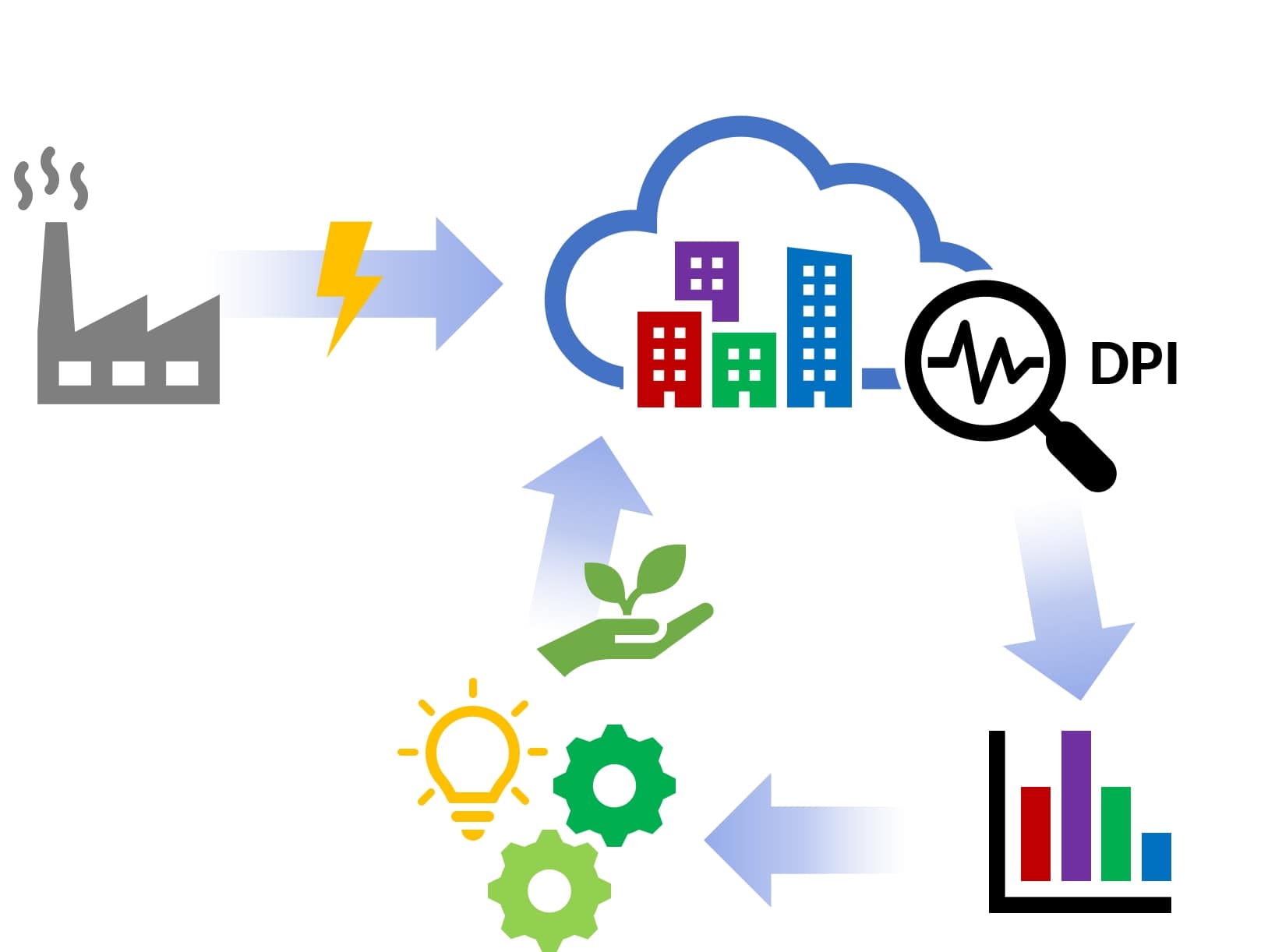
An organization typically has various enterprise apps and IoTs systems. An organization typically has various enterprise apps and Internet of Things (IoT) systems. The usages of these systems are typically well reflected by the packets transmitted to the network. This paper presents a unique approach to strive for energy savings in organizations by exploiting fact observables in networks. DPI is employed to dissect passing network packets and predict their protocols. Data Plan Development Kit (DPDK) is adopted to push the hardware limit and speed up the inspection. A webbased customizable dashboard is incorporated to allow human observation according to the characteristics of the organization. Several API endpoints are provided to extend the functionalities, such as ML/AI integration. An energy-sensing model is proposed to measure the energy usage or generation by various connected systems, such as IoTs, smart ACs, and solar panel controllers. The results demonstrate that the working prototype improves processing efficiency, enabling the system to handle large volumes of data up to 10GB, achieving an average packet processing efficiency of 99.991%. The system can also accurately identify various protocols, mapping the cybersecurity risks and anomalies, with an average packet loss rate of only 0.83%. The standardized UAT confirms the system’s usability, reliability, and robust security. The findings of this study are expected to provide a practical, reliable, efficient, and user-friendly network monitoring solution while contributing to the development of open-source and flexible network traffic monitoring and green technology.
Data Plane Development Kit (DPDK); Deep Packet Inspection (DPI); Energy efficiency; Green networking; nDPI
Ali, L. (2019). Cyber crimes-a constant
threat for the business sectors and its growth (a study of the online banking
sectors in gcc). Journal of Developing Areas, 53 (1), 253–265.
Attawna, M. D., Doan, T., Shadi, Doan,
T., Pham, F., & Nguyen, G. (2023). Leveraging data plane acceleration for
network coding deployment: A measurement study. Conference on Network Function
Virtualization and Software Defined Networks (NFV-SDN), 34–39. https://doi.org/10.1109/NFV-SDNS9219.2023.10329588
Azari, A., Salehi, F., Papapetrou, P.,
& Cavdar, C. (2022). Energy and resource efficiency by user traffic
prediction and classification in cellular networks. IEEE Transactions on Green
Communications and Networking, 6 (2), 1082–1095. https://doi.org/10.1109/TGCN.2021.3126286
Belkhiri, A., Pepin, M., Bly, M., & Dagenais, M. (2022). Performance
analysis of dpdk based applications through tracing. Journal of Parallel and
Distributed Computing, 173. https://doi.org/10.1016/j.jpdc.2022.10.012
Celebi, M., Ozbilen, A., & Yavano
?glu, U. (2023). A comprehensive survey on deep packet ?inspection for advanced
network traffic analysis: Issues and challenges. Ni ?gde Omer ?Halisdemir
Universitesi M ?uhendislik Bilimleri Dergisi
?, 12 (1), 1–29. https://doi.org/10.28948/ngumuh.1184020
Chairina, C., & Tjahjadi, B.
(2023). Green governance and sustainability report quality: The moderating role
of sustainability commitment in asean countries. Economies, 11 (1). https://doi.org/10.3390/economies11010027
Deri, L. (2021). Using ndpi for
monitoring and security (tech. rep.) (Accessed: 2025-09-18). ntop.org. https://www.ntop.org/
Deri, L., Cardigliano, A., & Fusco,
F. (2024). Advancements in traffic processing using programmable hardware flow
offload. https://arxiv.org/abs/2407.16231
Domingos, J. M. F., Marques, D. G.,
Campos, V., & Nolasco, M. A. (2024). Analysis of the water indicators in
the ui greenmetric applied to environmental performance in a university in
brazil. Sustainability, 16 (20). https://doi.org/10.3390/su16209014
Feliana, F., Harwahyu, R., &
Overbeek, M. V. (2023). Multichannel slotted aloha simulator design for massive
machine-type communication (mmtc) on 5g network. International Journal of
Electrical, Computer, and Biomedical Engineering, 1 (2), 72–102. https://doi.org/10.62146/ijecbe.v1i2.8
Ghosh, A., & Senthilrajan, A.
(2019). Research on packet inspection techniques. International Journal of
Scientific Technology Research, 8, 2068–2073.
Hananto, A. L., Tirta, A., Herawan, S. G., Idris, M., Soudagar, M. E. M.,
Djamari, D. W., & Veza, I. (2024). Digital twin and 3d digital twin:
Concepts, applications, and challenges in industry 4.0 for digital twin.
Computers, 13 (4). https://doi.org/10.3390/computers13040100
Harwahyu, R., Ndolu, F. H. E., &
Overbeek, M. V. (2024). Three layer hybrid learning to improve intrusion
detection system performance. International Journal of Electrical &
Computer Engineering (IJECE), 14 (2), 1691–1699. https://doi.org/10.11591/ijece.v14i2.pp1691-1699
Ibrahim, A. (2024, January).
Integration of machine learning models in a microservices architecture [Master
of Science]. Polytechnic Institute of Bragan ?ca. https://share.google/QE9izRn5hndunaxXB
Imran, A., Wahid, M. S. N., Baso, F.,
& Fadil, A. (2024). Development monitoring information system based on
website and whatsapp gateway at sd telkom makassar. Journal of Embedded
Systems, Security and Intelligent Systems, 5 (3), 240–248. https://doi.org/10.59562/jessi.v5i3.5193
Jha, A., Singh, S. R., & Meenakshi. (2022). Human–machine
convergence and disruption of socio-cognitive capabilities. International
Journal of Next-Generation Computing, 13 (3), 754–762. https://doi.org/10.47164/ijngc.v13i3.893
Jia, M., Komeily, A., Wang, Y., & Srinivasan, R. (2019). Adopting
internet of things for the development of smart buildings: A review of enabling
technologies and applications. Automation in Construction, 101, 111–126. https://doi.org/10.1016/j.autcon.2019.01.023
Joarder, Y. A., & Fung, C. (2024). Exploring quic security and
privacy: A comprehensive survey on quic security and privacy vulnerabilities,
threats, attacks, and future research directions. IEEE Trans. on Netw. and
Serv. Manag., 21 (6), 6953–6973. https://doi.org/10.1109/TNSM.2024.3457858
Jonnavithula, S., Jain, I., &
Bharadia, D. (2024). Mimo-ric: Ran intelligent controller for mimo xapps.
Proceedings of the Annual International Conference on Mobile Computing and
Networking (MobiCom), 2315–2322. https:// doi.org/10.1145/3636534.3701548
Kemp, S. (2024, January). Internet use
in 2024 [Accessed 2025-09-17]. https://datareportal.com/reports/digital-2024-deep-dive-the-state-of-internet-adoption
Kusrini, E., Whulanza, Y., Ramakrishna,
S., & Nurhayati, R. W. (2023). Advancing green growth through innovative
engineering solutions. International Journal of Technology, 14 (7), 1402–1407. https://doi.org/10.14716/ijtech.v14i7.6869
Ozbay, Z. N., & Dalk?l? ?c, M. E.
(2023). Ndpi derin paket inceleme arac?
?uzerinde bir ? ?cal? ?sma. T
?urkiye Bili ?sim Vakf? Bilgisayar Bilimleri ve M ?uhendisli ?gi Dergisi, 16
(2), 137–146. https://doi.org/10.54525/tbbmd.1253700
Park, S., Flaxman, A., & Schultz, M. (2021). Impact of data
visualization on decision-making and its implications for public health
practice: A systematic literature International Journal of Technology 16(6)
1-22 (2025) 21 review. Informatics for Health and Social Care, 47, 1–19. https://doi.org/10.1080/17538157.2021.1982949
Ramey, H. (2024, May). Understanding
the limits of deep packet inspection for network traffic classification [Master
of Science]. University of Texas at El Paso. https://scholarworks.utep.edu/open
etd/4136/
Raza, M., Kazmi, S., Ali, R., Naqvi, M.
M. A., Fiaz, H., & Akram, A. (2024). High performance dpi engine design for
network traffic classification, metadata extraction and data visualization.
Proceedings of the International Conference on Advancements in Computational
Sciences (ICACS), 1–6. https://doi.org/10.1109/ICACS60934.2024.10473274
Rehman, S. U., Giordino, D., Zhang, Q., & Alam, G. M. (2023). Twin
transitions industry 4.0: Unpacking the relationship between digital and green
factors to determine green competitive advantage. Technology in Society, 73,
102227. https://doi.org/10.1016/j.techsoc.2023.102227
Sapp, S., Dorius, S., Bertelson, K., & Harper, S. (2021). Public
support for government use of network surveillance: An empirical assessment of
public understanding of ethics in science administration. Public Understanding
of Science, 31, 096366252110495. https://doi.org/10.1177/09636625211049531
Sarasola, T. F. D. B., GarcAa, A.,
& Ferrando, J. L. (2024). Iiot protocols for edge/fog ? and cloud computing in industrial ai: A
high frequency perspective. International Journal of Cloud Applications and
Computing (IJCAC), 14 (1), 1–30.
Sarhan, S., Youness, H., Bahaa-Eldin, A., & Taha, A. (2024). Voip
network forensics of instant messaging calls. IEEE Access, 12, 9012–9024. https://doi.org/10.1109/ACCESS.2024.3352897
Shirota, Y., Presekal, A., & Sari,
R. F. (2019). Visualization of time series data by statistical shape analysis
on fertility rate and education in indonesia. Journal of Advances in
Information Technology, 10 (2), 60–65. https://doi.org/10.12720/jait.10.2.60-65
Vailshery, L. S. (2024, September).
Number of internet of things (iot) connections worldwide from 2022 to 2023,
with forecasts from 2024 to 2033 [Accessed 2025-09-17]. https://www.statista.com/statistics/1183457/iot-connected-devices-worldwide/
Vorbrodt, M. (2023, February).
Analyzing the performance of linux networking approaches for packet processing:
A comparative analysis of dpdk, io uring and the standard linux network stack
[Master’s thesis, Link ?oping University] [Retrieved from DiVA portal]. https://www.diva-portal.org/smash/get/diva2%5C%3A1789103/FULLTEXT01.pdf
Wang, S., Qian, L., Yi, C., Wu, F., Kou, Q., Li, M., Chen, X., & Lan,
X. (2024). Sadma: Scalable asynchronous distributed multi-agent
reinforcement learning training framework. International Workshop on
Engineering Multi-Agent Systems (EMAS), 64–81. https://doi.org/10.1007/978-3-031-71152-7
4
Whulanza, Y. (2023). Cohering existing
technology with greener and modern innovation. International Journal of
Technology, 14 (2), 232–235. https://doi.org/10.14716/ijtech.v14i2.6435
Yen, T. A. (2021). Flexips: A
keep-tracking scalable network function design and implementation. 2021 2nd
International Conference on Electronics, Communications and Information
Technology (CECIT), 607–613. https://doi.org/10.1109/CECIT53797.2021.00112
Zagloel, T. Y. M., Harwahyu, R.,
Maknun, I. J., Kusrini, E., & Whulanza, Y. (2023). Developing models and
tools for exploring the synergies between energy transition International
Journal of Technology 16(6) 1-22 (2025) 22 and the digital economy.
International Journal of Technology, 14 (8), —. https://doi.org/10.14716/ijtech.v14i8.6906
Zhu, J., He, S., He, P., Liu, J., &
Lyu, M. R. (2023). Loghub: A large collection of system log datasets for
ai-driven log analytics. Proceedings of the 2023 IEEE 34th International
Symposium on Software Reliability Engineering (ISSRE), 355–366. https://doi.org/10.1109/ISSRE59848.2023.00071