
Land Value Capture Potential of Jakarta’s LRT: Early Post-Operational Evidence from Residential Property Prices in TOD Zones
Corresponding email: mustikasarisayuti@gmail.com
Published at : 28 Jan 2026
Volume : IJtech
Vol 17, No 1 (2026)
DOI : https://doi.org/10.14716/ijtech.v17i1.8024
| Muhamad Kemal Ibrahim | Urban and Regional Planning Study Program, Department of Interdisciplinary Engineering, Faculty of Engineering, Universitas Indonesia, Depok, 16424, Indonesia |
| Mustika Sari | 1. Department of Civil and Environmental Engineering, Faculty of Engineering, Universitas Indonesia, Depok, 16424, Indonesia 2. Center for Sustainable Infrastructure Development, Faculty of Engineeri |
| Gunawan Saroji | Department of Civil Engineering, Politeknik Negeri Bengkalis, Bengkalis, 28711, Indonesia |
| Siti Hafsah Zulkarnain | Centre of Studies for Real Estate, Faculty of Built Environment, Universiti Teknologi MARA, Shah Alam, 40450, Malaysia |
| Cheah Chan Fatt | Ungku Aziz Centre for Development Studies, Universiti Malaya, Kuala Lumpur, 50603, Malaysia |
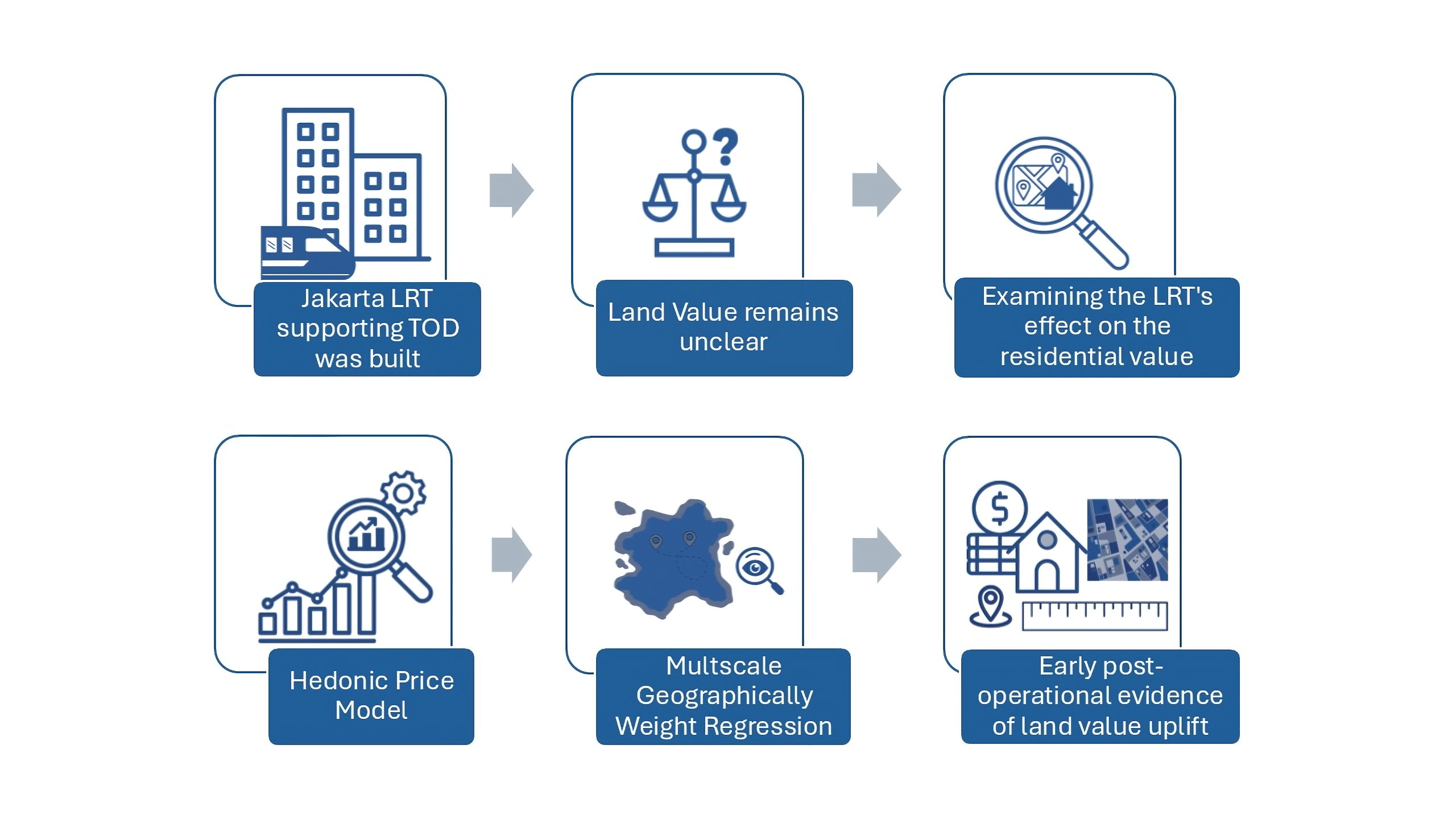
Jakarta’s recent light rail transit (LRT) development has been promoted as part of a broader transit-oriented development (TOD) agenda. However, empirical evidence on whether early-stage operations influence surrounding land values is limited. This study examines residential land prices within 1 km of the Dukuh Atas–Cawang LRT corridor to assess the roles of structural property attributes and proximity to urban amenities. A dataset of 97 residential properties was analyzed using a hedonic price model (HPM) to identify significant predictors and a Multiscale Geographically Weighted Regression (MGWR) to capture spatial variation in their effects. The results show that building area, proximity to high schools, and proximity to the central business district (CBD) are positively associated with land prices, while distance to LRT stations has no significant effect. These findings indicate that accessibility to key amenities currently outweighs transit access in shaping land values. The study contributes to TOD and Land Value Capture (LVC) research in Southeast Asia by providing post-operational evidence from an emerging megacity context and suggests that coordinated urban design, land use integration, and station area improvements are required for LRT investments to generate measurable value uplift.
Hedonic price model; Land value capture; Residential property; LRTJabodebek; Transit-Oriented development
Alberto,
E., & Nobre, C. (2023). Implementing land value capture in a global south
city: Evaluation of the experience in the city of sao paulo, brazil. Revista Brasileira de Estudos Urbanos e
Regionais, 25, e202327. https://doi.org/10.22296/2317-1529.RBEUR.202327PT
Bax,
D., Zewotir, T., & North, D. (2019). A gamma generalised linear model as an
alternative to log linear real estate price functions. Journal of Economic and
Financial Sciences, 12 (1), 1–11. https://doi.org/10.4102/jef.v12i1.476
Berawi, M. A., Aprianti, L., Saroji, G., Sari, M., Miraj,
P., & Kim, A. A. (2020). Land
value capture modeling in residential area using big data approach method.
Engineering Journal, 24 (4), 249–259. https://doi.org/10.4186/ej.2020.24.4.249
Berawi, M. A., Miraj, P., Saroji, G., & Sari, M.
(2020). Impact of
rail transit station proximity to commercial property prices: Utilizing big
data in urban real estate. Journal of Big Data, 7 (1). https://doi.org/10.1186/s40537-020-00348-z
Berawi,
M. A., Suwartha, N., Kurnia, K., Gunawan, Miraj, P., & Berawi, A. R. B.
(2018). Forecasting the land value around commuter rail stations using hedonic
price modeling. International Journal of Technology, 9 (7), 1329–1337. https://doi.org/10.14716/ijtech.v9i7.2589
Berawi, M. A., Suwartha, N., Salim, A. V., Saroji, G.,
& Sari, M. (2021). Developing
mobile application for land value capture scheme to finance urban rail transit
projects. International Journal of Technology, 12 (7), 1448–1457.
Cui, L., Li, H., Ma, X., & Gu, H. (2022). Using the hedonic model to analyze how the characteristics impact
the housing price in beijing during 2011–2018. ACM International Conference
Proceeding Series, 235–242. https://doi.org/10.1145/3572647.3572682
Dai,
X., Bai, X., & Xu, M. (2016). The influence of beijing rail transfer
stations on surrounding housing prices. Habitat International, 55, 79–88. https://doi.org/10.1016/j.habitatint.2016.02.008
Darendra, N. S., & Riyanto, E. (2025). Hedonic pricing model (hpm) on south tangerang residential
property value. Planning Malaysia, 23 (1), 319–333. https://doi.org/10.21837/PM.V23I35.1681
Deaconu,
A., Lazar, D., Buiga, A., & Fatacean, G. (2016). Marginal prices of
improvements made to blocks of flats: Empirical evidence from romania.
International Journal of Strategic Property Management, 20 (2), 156–171. https://doi.org/10.3846/1648715X.2015.1121415
Dhindaw,
J., Kumaraswamy, S. K., Prakash, S., Chanchani, R., & Deb, A. (2021).
Synergizing land value capture and transit-oriented development: A study of
bengaluru metro. World Resources Institute. https://doi.org/10.46830/wripn.20.00082
Endo, K., Edelenbos, J., & Gianoli, A. (2024). Finance arrangements and governance modes toward sustainable
infrastructure: The case of urban railway projects in manila, the philippines.
Discover Sustainability, 5 (1), 1–25. https://doi.org/10.1007/S43621-02400405-0
Gunawan, Berawi, M. A., & Sari, M. (2020). Optimizing property income in transit oriented development: A case
study of jakarta tod. Civil Engineering and Architecture, 8 (2), 136–143. https://doi.org/10.13189/cea.2020.080211
Hasibuan,
H. S., & Mulyani, M. (2022). Transit-oriented development: Towards
achieving sustainable transport and urban development in jakarta metropolitan,
indonesia. Sustainability, 14 (9), 5244. https://doi.org/10.3390/su14095244
Huang,
Y., & Dallerba, S. (2021). Does proximity to school still matter once
access to your preferred school zone has already been secured? Journal of Real
Estate Finance and Economics, 62 (4), 548–577. https://doi.org/10.1007/s11146-020-09761-w
Jaroszewicz,
J., & Horynek, H. (2024). Aggregated housing price predictions with no
information about structural attributes—hedonic models: Linear regression and a
machine learning approach. Land, 13 (11), 1881. https://doi.org/10.3390/land13111881
Karina,
K., Sumabrata, J., & Berawi, M. A. (2025). Ridership optimization model of
transit-oriented development in jakarta. International Journal of Technology,
16 (4), 1348. https://doi.org/10.14716/ijtech.v16i4.6522
Kashkooli, H. N., Soltani, A., & Javidi, F. (2025). The impact of public transportation accessibility on apartment
prices in shiraz: A comparative study in a developing urban context. Eco
Cities, 6 (2), 3406. https://doi.org/10.54517/ec3406
Kumar, V. S. S., Yoonus, S., & Anjaneyulu, M. V. L.
R. (2024). Development
of a land price model for a medium sized indian city. International Real Estate
Review, 27 (2), 121–140.
Lee,
J. K. (2022). New rail transit projects and land values: The difference in the
impact of rail transit investment on different land types, values and
locations. Land Use Policy, 112, 105807. https://doi.org/10.1016/j.landusepol.2021.105807
Li,
J., & Huang, H. (2020). Effects of transit-oriented development (tod) on
housing prices: A case study in wuhan, china. Research in Transportation
Economics, 80, 100813. https://doi.org/10.1016/j.retrec.2020.100813
Liu,
X., Chen, X., Orford, S., Tian, M., & Zou, G. (2024). Does better
accessibility always mean higher house prices? Environment and Planning B:
Urban Analytics and City Science, 51 (9), 2179–2195.
Lu,
Y., Shi, V., & Pettit, C. J. (2023). The impacts of public schools on
housing prices of residential properties: A case study of greater sydney,
australia. ISPRS International Journal of Geo-Information, 12 (7), 298. https://doi.org/10.3390/ijgi12070298
Mueller,
J. M., Loomis, J. B., Richardson, L., & Fitch, R. A. (2022). Valuing
impacts of proximity to saguaro national park on house prices. Applied Economic
Perspectives and Policy, 44 (3), 1359–1372.
Muhammad,
A., Burhan, B., & Safian, E. (2024). Price model for transit-oriented
developments in kuala lumpur, malaysia. Real Estate Management and Valuation,
32 (3), 20–30. https://doi.org/10.2478/remav-2024-0022
Munoz-Raskin,
R. (2010). Walking accessibility to bus rapid transit: Does it affect property values?
the case of bogota, colombia. Transport Policy, 17 (2), 72–84. https://doi.org/10.1016/j.tranpol.2009.11.002
Pilgram,
C. A., & West, S. E. (2018). Fading premiums: The effect of light rail on
residential property values in minneapolis, minnesota. Regional Science and
Urban Economics, 69, 1–10. https://doi.org/10.1016/j.regsciurbeco.2017.12.008
Pramudita,
W., & Nataadmadja, A. (2023). Analysis of the performance of light rail
transit (lrt) jakarta as a transport demand management (tdm) strategy. IOP
Conference Series: Earth and Environmental Science, 1169 (1), 012021. https://doi.org/10.1088/1755-1315/1169/1/012021
Rehak, S., Kacer, M., & Wang, K. (2018). Estimating distance gradient in bratislava with different types of
distance measurements. 25th Annual European Real Estate Society Conference. https://doi.org/10.15396/ERES2018_259
Sharma,
R., & Newman, P. (2018). Can land value capture make ppps competitive in
fares? A mumbai case study. Transport Policy, 64, 123–131. https://doi.org/10.1016/j.tranpol.2018.02.002
Su, S., Zhang, J., He, S., Zhang, H., Hu, L., & Kang,
M. (2021). Unraveling
the impact of tod on housing rental prices and implications on spatial
planning: A comparative analysis of five chinese megacities. Habitat
International, 107, 102309. https://doi.org/10.1016/j.habitatint.2020.102309
Vergel-Tovar, C. E., Garcia, J. S., Alvarez, J. P., Mesa,
S., Molano, I. L., Canon-Rubiano, L., & Correa-Garzon, L. M. (2025). Estimation of the anticipation effects of the metro project on
real estate dynamics in bogota, colombia. Journal of Transport and Land Use, 18
(1), 123–173. https://doi.org/10.5198/jtlu.2025.2593
Wang, Y., Liu, Z., Wang, Y., & Dai, P. (2025). Research on spatial differentiation of housing prices along the
rail transit lines in qingdao city based on multi-scale geographically weighted
regression analysis. Sustainability, 17 (9), 4203. https://doi.org/10.3390/su17094203
Wei, C., Fu, M., Wang, L., Yang, H., Tang, F., &
Xiong, Y. (2022). The research
development of hedonic price model-based real estate appraisal in the era of
big data. Land, 11 (3), 334. https://doi.org/10.3390/land11030334
Xu,
T., & Zhang, M. (2016). Tailoring empirical research on transit access
premiums for planning applications. Transport Policy, 51, 49–60. https://doi.org/10.1016/j.tranpol.2016.03.003
Yang, L., Chau, K. W., Szeto, W. Y., Cui, X., & Wang,
X. (2020). Accessibility
to transit, by transit, and property prices: Spatially varying relationships.
Transportation Research Part D: Transport and Environment, 85, 102387. https://doi.org/10.1016/j.trd.2020.102387
Yin, Z., Li, W., Li, C., & Zheng, Y. (2025). The relationship between accessibility and land prices: A focus on
accessibility to transit in the 15-min city. Travel Behaviour and Society, 38, 100914.
https://doi.org/10.1016/j.tbs.2024.100914
Zhang,
M., & Xu, T. (2017). Uncovering the potential for value capture from rail
transit services. Journal of Urban Planning and Development, 143 (3), 04017006.
https://doi.org/10.1061/(ASCE)UP.1943-5444.0000383
Zhang, W., Lin, L., Zhu, Q., Chen, D., & Ha, W.
(2025). The effects
of new satellite campuses on land prices: Evidence based on micro land
transaction data in china. Applied Geography, 176, 103528. https://doi.org/10.1016/j.apgeog.2025.103528
Zhou, Y., Tian, Y., Jim, C. Y., Liu, X., Luan, J., & Yan, M. (2022). Effects of public transport accessibility and property attributes on housing prices in polycentric beijing. Sustainability, 14 (22), 14743. https://doi.org/10.3390/su142214743
Zulkarnain & Arvianti. (2021). An analysis of implicit value of property characteristics in residential property prices using a hedonic value approach. International Journal of Technology, 12 (6), 1168–1176. https://doi.org/10.14716/IJTECH.V12I6.5216