
Formulating an Electric Vehicle Adoption Model in Indonesia: Product Quality, Consumer Characteristics, Adoption Context, and Perception
Corresponding email: rahmat@eng.ui.ac.id
Published at : 01 Dec 2025
Volume : IJtech
Vol 16, No 6 (2025)
DOI : https://doi.org/10.14716/ijtech.v16i6.7804
Lazuardy, A., Nurcahyo, R., Farizal, F., & Oktavina, R. (2025). Formulating an electric vehicle adoption model in indonesia: Product quality, consumer characteristics, adoption context, and perception. International Journal of Technology, 16 (6), 2122–2142.
| Ardhy Lazuardy | 1. Industrial Engineering Department, Faculty of Engineering, Universitas Indonesia, Depok, Indonesia 2. Industrial Engineering Department, Faculty of Industrial Technology, Gunadarma University, Dep |
| Rahmat Nurcahyo | 1. Industrial Engineering Department, Faculty of Engineering, Islamic University of Madinah, Saudi Arabia 2. Industrial Engineering Department, Faculty of Engineering, Universitas Indonesia, Depok, I |
| Farizal Farizal | Industrial Engineering Department, Faculty of Engineering, Universitas Indonesia, Depok, Indonesia |
| Rakhma Oktavina | Industrial Engineering Department, Faculty of Industrial Technology, Gunadarma University, Depok, Indonesia |
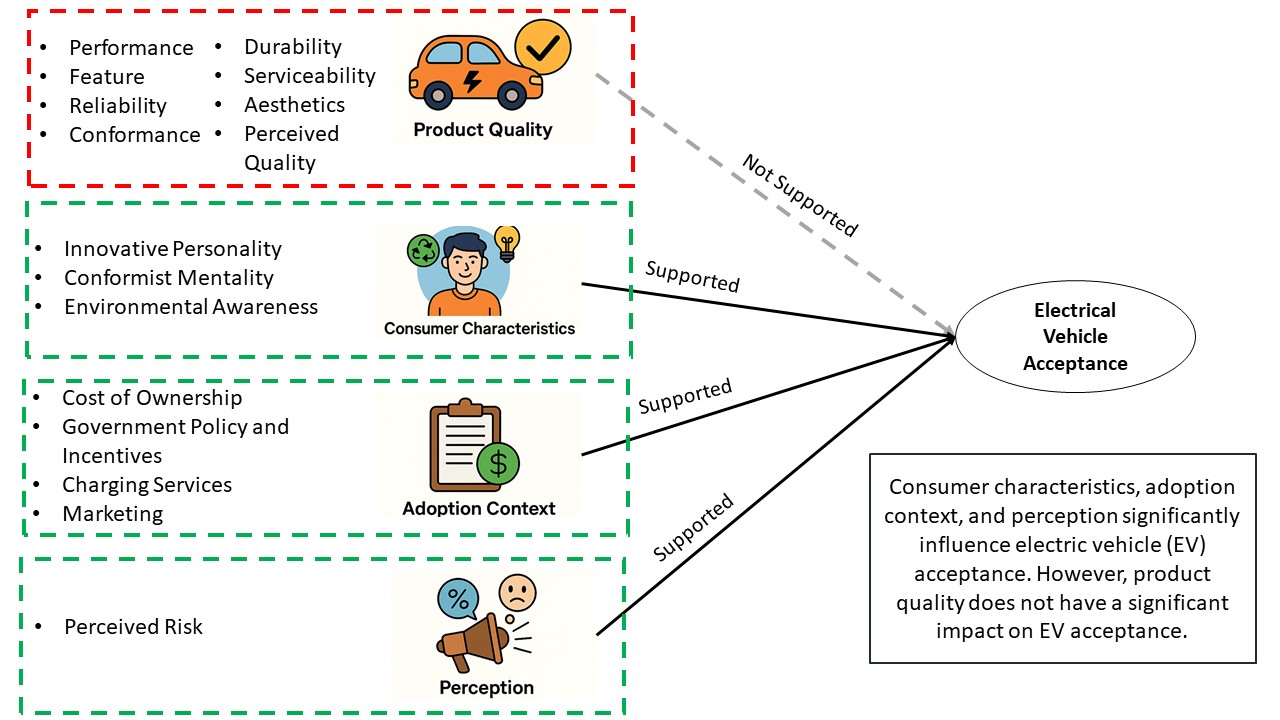
In Indonesia, the transition to electric vehicles (EVs) is a crucial strategy for promoting sustainable mobility and reducing carbon emissions. This study investigates the key factors influencing EV acceptance in the Indonesian context, focusing on four primary constructs: product quality, consumer characteristics, adoption context, and perception. Data were collected from 181 respondents who are financially able to purchase an EV and currently own a private vehicle using a two-stage partial least squares structural equation modeling (PLS-SEM) approach. The study found that consumer characteristics (e.g., innovative personality and environmental awareness) and adoption context factors (e.g., government incentives and charging infrastructure) significantly influence EV acceptance. However, product quality (including performance, reliability, and durability) and perception of EVs (e.g., range anxiety, battery concerns) had weaker effects on adoption decisions. Interestingly, the perception of EVs had a positive influence, suggesting that public education and effective communication can mitigate consumer concerns. The quantitative results indicate that consumer characteristics and adoption context together explain 61.8% of the variance in EV acceptance. This study contributes to the literature on technology adoption in emerging markets by highlighting the specific challenges and opportunities in Indonesia’s context of EV adoption. It provides actionable recommendations for policymakers and industry stakeholders to accelerate the transition to low-emission transportation.
Consumer acceptance; Electric vehicles; financial capability; Indonesia; Product quality
Agrawal, S., Peeta, S., &
Miralinaghi, M. (2023). Multiparadigm modeling framework to evaluate the
impacts of travel patterns on electric vehicle battery lifespan. Journal of
Advanced Transportation, 2023, 1689075. https://doi.org/10.1155/2023/1689075
Ajzen, I. (1991). The theory of planned
behavior. Organizational Behavior and Human Decision Processes, 50,
179–211. https://doi.org/10.1016/0749-5978(91)90020-T
Aqmarina, S., Nurcahyo, R., & Sumaedi, S. (2024). Accelerating
electric motorcycle adoption: Comparison between users and non-users
perspectives in Jakarta, Indonesia. TEM Journal, 13, 1633–1644. https://doi.org/10.18421/TEM132-76
Aravindan, K. L., Izzat, M. A.,
Ramayah, T., Chen, T. S., Choong, Y. V., Annamalah, S., Ilhavenil, N., &
Ahmad, A. B. (2023). Determinants of electric car patronage intention. International
Journal of Technology, 14, 1393–1401. https://doi.org/10.14716/ijtech.v14i6.6624
Armstrong, J. S., & Overton, T. S.
(1977). Estimating nonresponse bias in mail surveys. Journal of Marketing
Research, 14, 396–402. https://doi.org/10.2307/3150783
Avci, B., Girotra, K., & Netessine,
S. (2015). Electric vehicles with a battery switching station: Adoption and
environmental impact. Management Science, 61, 772–794. https://doi.org/10.1287/mnsc.2014.1916
Axsen, J., & Kurani, K. S. (2012).
Interpersonal influence within car buyers’ social networks: Applying five
perspectives to plug-in hybrid vehicle drivers. Environment and Planning A:
Economy and Space, 44, 1047–1065. https://doi.org/10.1068/a43221x
Bhat, F. A., Verma, M., & Verma, A. (2021). Measuring and
modelling electric vehicle adoption of Indian consumers. Transportation in
Developing Economies, 8, 6. https://doi.org/10.1007/s40890-021-00143-2
Bindhya, M. S., Kartha, N. V. M.,
Jacob, G., Lukose, A., & Joseph, J. (2024). Electrifying the road: A
comprehensive analysis of factors influencing consumer adoption of electric
vehicles. International Journal of Energy Economics and Policy, 15,
552–565. https://doi.org/10.32479/ijeep.17036
Bindhya, M. S., Madhusoodanan Kartha, N. V., Jacob, G., Lukose, A., &
Joseph, J. (2025). Electrifying the road: A comprehensive analysis of
factors influencing consumer adoption of electric vehicles. International
Journal of Energy Economics and Policy, 15, 552–565. https://doi.org/10.32479/ijeep.17036
Brand, S., Petri, M., Haas, P., Krettek, C., & Haasper, C. (2013). Hybrid
and electric low-noise cars cause an increase in traffic accidents involving
vulnerable road users in urban areas. International Journal of Injury
Control and Safety Promotion, 20, 339–341. https://doi.org/10.1080/17457300.2012.733714
Bry?a, P., Chatterjee, S., &
Ciabiada-Bry?a, B. (2023). Consumer adoption of electric vehicles: A systematic
literature review. Energies, 16, 205.
Chidambaram, K., Ashok, B., Rajasekar,
V., Deepak, C., Ramesh, R., Narendhra, T., Muhammad Usman, K., & Kavitha,
C. (2022). Critical analysis on the implementation barriers and consumer
perception toward future electric mobility. Proceedings of the Institution
of Mechanical Engineers, Part D: Journal of Automobile Engineering, 237,
09544070221080349. https://doi.org/10.1177/09544070221080349
Chinen, K., Matsumoto, M., Liu, C.,
Tong, P., Han, Y. S., & Endo, H. (2023). Expanding electric-vehicle
adoption beyond the national border: Insights for developing marketing policies
for global electric-vehicle manufacturers. International Journal of
Sustainable Transportation, 17, 393–405. https://doi.org/10.1080/15568318.2022.2045652
Choi, H., & Oh, I. (2010). Analysis
of product efficiency of hybrid vehicles and promotion policies. Energy
Policy, 38, 2262–2271. https://doi.org/10.1016/j.enpol.2009.12.014
Daramy-Williams, E., Anable, J., &
Grant-Muller, S. (2019). A systematic review of the evidence on plug-in
electric vehicle user experience. Transportation Research Part D: Transport
and Environment, 71, 22–36. https://doi.org/10.1016/j.trd.2019.01.008
Davis, F. D. (1989). Perceived
usefulness, perceived ease of use, and user acceptance of information
technology. MIS Quarterly, 13, 319–340. https://doi.org/10.2307/249008
Deloitte. (2023). 2023 global
automotive consumer study Southeast Asia perspectives. https://www2.deloitte.com/content/dam/Deloitte/sg/Documents/consumer-business/sea-cb-2023-global-automotive-consumer-study-southeast-asia-perspectives.pdf
Dhairiyasamy, R., & Gabriel, D.
(2025). Sustainable mobility in India: Advancing domestic production in the
electric vehicle sector. Discover Sustainability, 6, 52. https://doi.org/10.1007/s43621-025-00844-3
Dua, R. (2024). Net-zero transport
dialogue: Emerging developments and the puzzles they present. Energy for
Sustainable Development, 82, 101516. https://doi.org/10.1016/j.esd.2024.101516
Dua, R., Hardman, S., Bhatt, Y., &
Suneja, D. (2021). Enablers and disablers to plug-in electric vehicle adoption
in India: Insights from a survey of experts. Energy Reports, 7,
3171–3188. https://doi.org/10.1016/j.egyr.2021.05.025
Fan, B., Wen, Z., & Qin, Q. (2024).
Competition and cooperation mechanism of new energy vehicle policies in China’s
key regions. Humanities and Social Sciences Communications, 11, 1640. https://doi.org/10.1057/s41599-024-04167-y
Figenbaum, E. (2017). Perspectives on
Norway’s supercharged electric vehicle policy. Environmental Innovation and
Societal Transitions, 25, 14–34. https://doi.org/10.1016/j.eist.2016.11.002
Fornell, C., & Larcker, D. F.
(1981). Evaluating structural equation models with unobservable variables and
measurement error. Journal of Marketing Research, 18, 39–50. https://doi.org/10.2307/3151312
Gaikindo. (2023). Indonesian
automobile industry data.
Garvin, D. A. (1984). What does
“product quality” really mean? Sloan Management Review, 25, 25–43.
Garvin, D. A. (1987). Competing on the
eight dimensions of quality. Harvard Business Review, 101–109.
Gomez, R., Swann, L., Florentzos, P.,
& Singleton, A. (2024). Automotive interior design in the age of electric
vehicles: User interface expectations, perceptions and preferences. AutomotiveUI
2024 Adjunct Proceedings, 82–87. https://doi.org/10.1145/3641308.3685028
Gorevaya, E., & Spiridonova, E.
(2023). Forecast of the development of demand for charging points for electric
vehicles in Russian cities. E3S Web of Conferences. https://doi.org/10.1051/e3sconf/202337604021
Graham-Rowe, E., Gardner, B., Abraham,
C., Skippon, S., Dittmar, H., Hutchins, R., & Stannard, J. (2012).
Mainstream consumers driving plug-in battery-electric and plug-in hybrid
electric cars: A qualitative analysis of responses and evaluations. Transportation
Research Part A: Policy and Practice, 46, 140–153. https://doi.org/10.1016/j.tra.2011.09.008
Gulzari, A., Wang, Y., & Prybutok,
V. (2022). A green experience with eco-friendly cars: A young consumer electric
vehicle rental behavioral model. Journal of Retailing and Consumer Services,
65, 102877. https://doi.org/10.1016/j.jretconser.2021.102877
Gunawardane, N., & Dk, T. (2019).
The effect of perceived risk on the purchase intention of electric vehicles: An
extension to the technology acceptance model. International Journal of
Electric and Hybrid Vehicles, 11, 73. https://doi.org/10.1504/IJEHV.2019.10020148
Guo, Q., Liu, Y., & Cai, L. (2023).
An experimental study on the potential purchase behavior of Chinese consumers
of new energy hybrid electric vehicles. Frontiers in Environmental Science,
11. https://doi.org/10.3389/fenvs.2023.1159846
Habiburrahman, M., Nurcahyo, R.,
Ma’aram, A., & Natsuda, K. (2024). Driving the transport electrification:
Exploring stakeholders’ perceptions and actions in the Indonesian automotive
industry transition to electric mobility. Sustainability, 16, 5855. https://doi.org/10.3390/su16145855
Habiburrahman, M., Tri Setyoko, A.,
Nurcahyo, R., Daulay, H., & Natsuda, K. (2025). Circular economy strategy
for waste management companies of electric vehicle batteries in Indonesia. International
Journal of Productivity and Performance Management, 74, 21–45. https://doi.org/10.1108/IJPPM-01-2024-0015
Hair, J., Hult, G. T. M., Ringle, C.,
& Sarstedt, M. (2022). A primer on partial least squares structural
equation modeling (PLS-SEM). SAGE Publications.
Hair Jr., J. F., Hult, G. T. M.,
Ringle, C. M., Sarstedt, M., Danks, N. P., & Ray, S. (2021). Partial
least squares structural equation modeling (PLS-SEM) using R: A workbook.
Springer Nature.
Hakam, D. F., & Jumayla, S. (2024).
Electric vehicle adoption in Indonesia: Lesson learned from developed and
developing countries. Sustainable
Futures, 8, 100348. https://doi.org/10.1016/j.sftr.2024.100348
Halder, P., Hansen, E. N., Kangas, J., & Laukkanen, T. (2020). How
national culture and ethics matter in consumers’ green consumption values. Journal
of Cleaner Production, 265, 121754. https://doi.org/10.1016/j.jclepro.2020.121754
Hardman, S., & Tal, G. (2016).
Exploring the decision to adopt a high-end battery electric vehicle: Role of
financial and nonfinancial motivations. Transportation Research Record,
2572, 20–27. https://doi.org/10.3141/2572-03
Henseler, J., Ringle, C. M., &
Sarstedt, M. (2016). Testing measurement invariance of composites using partial
least squares. International Marketing Review, 33, 405–431. https://doi.org/10.1108/imr-09-2014-0304
Herziger, A., Carrel, A. L., &
Sintov, N. (2025). When does symbolism matter most? Exploring electric vehicle
adoption intent through surveys in two United States cities. Energy Research
and Social Science, 119, 103818. https://doi.org/10.1016/j.erss.2024.103818
Hidrue, M. K., Parsons, G. R., Kempton,
W., & Gardner, M. P. (2011). Willingness to pay for electric vehicles and
their attributes. Resource and Energy Economics, 33, 686–705. https://doi.org/10.1016/j.reseneeco.2011.02.002
Higueras-Castillo, E., Singh, V.,
Singh, V., & Liébana-Cabanillas, F. (2023). Factors affecting adoption
intention of electric vehicle: A cross-cultural study. Environment,
Development and Sustainability, 26, 29293–29329. https://doi.org/10.1007/s10668-023-03865-y
Hildermeier, J., & Villareal, A.
(2014). Two ways of defining sustainable mobility: Autolib’ and BeMobility. Journal
of Environmental Policy & Planning, 16, 321–336. https://doi.org/10.1080/1523908X.2014.880336
Huang, X., & Ge, J. (2019).
Electric vehicle development in Beijing: An analysis of consumer purchase
intention. Journal of Cleaner Production, 216, 361–372. https://doi.org/10.1016/j.jclepro.2019.01.231
IEA. (2022). World energy outlook
2022. https://www.iea.org/reports/world-energy-outlook-2022
IEA. (2024). World energy outlook
2024. https://www.iea.org/reports/world-energy-outlook-2024
IESR. (2023). Indonesia electric
vehicle outlook 2023. https://iesr.or.id/pustaka/indonesia-electric-vehicle-outlook-ievo-2023/
Jansson, J., Nordlund, A., & Westin, K. (2017). Examining
drivers of sustainable consumption: The influence of norms and opinion
leadership on electric vehicle adoption in Sweden. Journal of Cleaner
Production, 154, 176–187. https://doi.org/10.1016/j.jclepro.2017.03.186
Jiang, Z., & Gao, X. (2024). Will
changes in charging and gasoline prices affect electric vehicle sales? Evidence
from China. Environmental Science and Pollution Research, 31, 3123–3133.
https://doi.org/10.1007/s11356-023-31389-5
Jing, X., Shudan, L., & Xiaoqin, H.
(2023). Study of production decisions and optimal subsidization of automakers
considering consumer environmental awareness. Journal of Industrial
Engineering and Engineering Management, 37, 71–79. https://doi.org/10.13587/j.cnki.jieem.2023.02.007
Lazuardy, A., Nurcahyo, R., &
Farizal, F. (2025). Analyzing total cost ownership between electric and
internal combustion engine city cars in Jakarta, Indonesia. Proceedings of
the ICSDI 2024, 401–408. https://doi.org/10.1007/978-981-97-8348-9_49
Lazuardy, A., Nurcahyo, R.,
Kristiningrum, E., Ma’aram, A., Aqmarina, S. N., & Rajabi, M. F. (2024).
Technological, environmental, economic, and regulation barriers to electric
vehicle adoption: Evidence from Indonesia. World Electric Vehicle Journal,
15, 422. https://doi.org/10.3390/wevj15090422
Li, W., Long, R., Chen, H., & Geng,
J. (2017). A review of factors influencing consumer intentions to adopt battery
electric vehicles. Renewable and Sustainable Energy Reviews, 78,
318–328. https://doi.org/10.1016/j.rser.2017.04.076
Ma, J., Li, T., & Gong, Z. (2017). Study on customer
satisfaction of electric vehicle product quality characteristic. Proceedings
of the International Conference on Mechanical Systems and Electrical
Engineering. https://doi.org/10.2991/icmse-17.2017.35
Mariasiu, F., Chereches, I. A., & Raboca, H. (2023). Statistical
analysis of the interdependence between the technical and functional parameters
of electric vehicles in the European market. Energies, 16, 2974. https://doi.org/10.3390/en16072974
Mekky, M. F., & Collins, A. R.
(2024). The impact of state policies on electric vehicle adoption: A panel data
analysis. Renewable and Sustainable Energy Reviews, 191, 114014. https://doi.org/10.1016/j.rser.2023.114014
Moon, S., & Lee, D.-J. (2019). An optimal electric vehicle
investment model for consumers using total cost of ownership: A real option
approach. Applied Energy, 253, 113494. https://doi.org/10.1016/j.apenergy.2019.113494
Muhammad Idris, I. G. T. E. B. S. S. W.
U. M. Z. A. (2025). Environmental impacts of internal combustion engine vs
electric vehicle: Life-cycle assessment review. International Journal of
Technology, 16, 291–319. https://doi.org/10.14716/ijtech.v16i3.7347
Naeem, H. M. Y., Bhatti, A. I., Butt,
Y. A., & Ahmed, Q. (2019). Velocity profile optimization of an electric
vehicle (EV) with battery constraint using Pontryagin’s minimum principle
(PMP). CCTA 2019 - 3rd IEEE Conference on Control Technology and
Applications, 750–755. https://doi.org/10.1109/CCTA.2019.8920609
Naik, S. C., Ali, A. H. M. H., Lobo, A. R., Sona, S. S., & Badiger, M.
(2024). A comprehensive review of electric vehicles: A smart choice for
environmental sustainability and energy conservation. In E-mobility in
Electrical Energy Systems for Sustainability. [Publisher unspecified].
Nunnally, J. C., & Bernstein, I. H. (1994). Psychometric
theory. McGraw-Hill.
Nurdini, A., Nurcahyo, R., &
Prabuwono, A. S. (2023). Waste from electric vehicle: A bibliometric analysis
from 1995 to 2023. World Electric Vehicle Journal, 14, 300. https://doi.org/10.3390/wevj14110300
Onggaria, E., Marhaendra, F., Nur
Pratama, I., Manurung, O., Nurdini, A., & Nurcahyo, R. (2023). Comparative
analysis of combustion and electric motorcycle as an alternative online-based
transportation in Indonesia. Proceedings of the International Conference on
Industrial Engineering and Operations Management, 574–580. https://doi.org/10.46254/AN13.20230171
Pamidimukkala, A., Kermanshachi, S.,
Rosenberger, J. M., & Hladik, G. (2024). Barriers and motivators to the
adoption of electric vehicles: A global review. Green Energy and Intelligent
Transportation, 3, 100153. https://doi.org/10.1016/j.geits.2024.100153
Pangeran, A., Shalahuddin, M.,
Prabaswara, R., Lazuardy, A., Nurcahyo, R., & Habiburrahman, M. (2024).
Factors influencing community willingness to buy electric motorcycles for green
transportation in Indonesia: Towards a sustainable and eco-friendly city. 2024
ASU International Conference in Emerging Technologies for Sustainability and
Intelligent Systems.
Plötz, P., Schneider, U., Globisch, J., & Dütschke, E. (2014). Who
will buy electric vehicles? Identifying early adopters in Germany. Transportation
Research Part A: Policy and Practice, 67, 96–109. https://doi.org/10.1016/j.tra.2014.06.006
Ponsree, K., Gebsombut, N., Paiyasen,
V., Archariyapibal, T., Srichiangwang, S., Nee, S., & Naruetharadhol, P.
(2020). Environmental awareness and adoption intention of electric cars in
young adult. Frontiers in Artificial Intelligence and Applications,
165–174. https://doi.org/10.3233/FAIA200649
PwC. (2023). Indonesia electric
vehicle consumer survey 2023. https://www.pwc.com/id/en/pwc-publications/industries-publications/consumer-and-industrial-products-and-services/automotive-survey-report-2023.html
PwC. (2024). The road ahead:
Indonesia’s electric vehicle readiness and consumer insights 2024. https://www.pwc.com/id/en/publications/automotive/indonesia-electric-vehicle-readiness-consumer-insights-2024.pdf
Raj, A., & Kumar, R. R. (2024). Understanding and enhancing
electric vehicle adoption in India: A practice-oriented approach. IEEE
Engineering Management Review, 52, 19–22. https://doi.org/10.1109/EMR.2024.3453554
Raykov, T., & Marcoulides, G. A.
(2011). Introduction to psychometric theory. Routledge/Taylor &
Francis Group.
Rezvani, Z., Jansson, J., & Bodin, J. (2015). Advances in
consumer electric vehicle adoption research: A review and research agenda. Transportation
Research Part D: Transport and Environment, 34, 122–136. https://doi.org/10.1016/j.trd.2014.10.010
Rogers, E. M. (2003). Diffusion of
innovations (5th ed.). Free Press.
Sasongko, T. W., Ciptomulyono, U.,
Wirjodirdjo, B., & Prastawa, A. (2024). Identification of electric vehicle
adoption and production factors based on an ecosystem perspective in Indonesia.
Cogent Business & Management, 11, 2332497. https://doi.org/10.1080/23311975.2024.2332497
Schuitema, G., Anable, J., Skippon, S.,
& Kinnear, N. (2013). The role of instrumental, hedonic and symbolic
attributes in the intention to adopt electric vehicles. Transportation
Research Part A: Policy and Practice, 48, 39–49. https://doi.org/10.1016/j.tra.2012.10.004
Setyoko, A. T., Nurcahyo, R., Gabriel, D. S., & Habiburrahman, M.
(2022). Policy, supporting infrastructure and market of electric cars in
Indonesia. Proceedings of the International Conference on Industrial
Engineering and Operations Management, 363–372. https://doi.org/10.46254/AN12.20220069
Shmueli, G., Ray, S., Velasquez
Estrada, J. M., & Chatla, S. B. (2016). The elephant in the room:
Predictive performance of PLS models. Journal of Business Research, 69,
4552–4564. https://doi.org/10.1016/j.jbusres.2016.03.046
Sierzchula, W., Bakker, S., Maat, K.,
& Van Wee, B. (2014). The influence of financial incentives and other
socio-economic factors on electric vehicle adoption. Energy Policy, 68,
183–194. https://doi.org/10.1016/j.enpol.2014.01.043
Siregar, A. D., Astari, F. I.,
Maharani, N. F. R., Lazuardy, A., Nurcahyo, R., & Habiburrahman, M. (2024).
Analysis of user satisfaction with battery electric vehicles: Toward green
transportation in Jakarta. 2024 ASU International Conference in Emerging
Technologies for Sustainability and Intelligent Systems (ICETSIS),
1178–1182. https://doi.org/10.1109/ICETSIS61505.2024.10459567
Skippon, S. M. (2014). How consumer
drivers construe vehicle performance: Implications for electric vehicles. Transportation
Research Part F: Traffic Psychology and Behaviour, 23, 15–31. https://doi.org/10.1016/j.trf.2013.12.008
Sovacool, B. K., Noel, L., Axsen, J.,
& Kempton, W. (2018). The neglected social dimensions to a vehicle-to-grid
(V2G) transition: A critical and systematic review. Environmental Research
Letters, 13, 013001. https://doi.org/10.1088/1748-9326/aa9c6d
Steinhilber, S., Wells, P., &
Thankappan, S. (2013). Socio-technical inertia: Understanding the barriers to
electric vehicles. Energy Policy, 60, 531–539. https://doi.org/10.1016/j.enpol.2013.04.076
Suwignjo, P., Yuniarto, M. N., Nugraha,
Y. U., Desanti, A. F., Sidharta, I., Wiratno, S. E., & Yuwono, T. (2023).
Benefits of electric motorcycle in improving personal sustainable economy: A
view from Indonesia online ride-hailing rider. International Journal of
Technology, 14, 38–53. https://doi.org/10.14716/ijtech.v14i1.5454
Triandis, H. C. (1995). Individualism
& collectivism. Westview Press.
Tsurvey. (2025). Vehicle survey:
Latest insights into car and motorcycle purchases.
Venkatesh, V., Morris, M., Davis, G.,
& Davis, F. (2003). User acceptance of information technology: Toward a
unified view. MIS Quarterly, 27, 425–478. https://doi.org/10.2307/30036540
Venkatesh, V., Thong, J., & Xu, X.
(2016). Unified theory of acceptance and use of technology: A synthesis and the
road ahead. Journal of the Association for Information Systems, 17,
328–376. https://doi.org/10.17705/1jais.00428
Wang, N., Tang, L., & Pan, H.
(2018). Analysis of public acceptance of electric vehicles: An empirical study
in Shanghai. Technological Forecasting and Social Change, 126, 284–291. https://doi.org/10.1016/j.techfore.2017.09.011
Wibowo, N., Piton, J. K., Nurcahyo, R.,
Gabriel, D. S., Farizal, F., & Madsuha, A. F. (2021). Strategies for
improving the e-waste management supply chain sustainability in Indonesia
(Jakarta). Sustainability, 13, 13955.
Widiawati, K., Sopha, B. M., &
Wardana, F. K. (2022). Public acceptance of electric vehicles in Indonesia. 2022
IEEE International Conference on Industrial Engineering and Engineering
Management (IEEM), 1301–1305. https://doi.org/10.1109/IEEM55944.2022.9989836
Wu, G., Inderbitzin, A., & Bening, C. (2015). Total cost of
ownership of electric vehicles compared to conventional vehicles: A
probabilistic analysis and projection across market segments. Energy Policy,
80, 196–214. https://doi.org/10.1016/j.enpol.2015.02.004
Xia, Z., Wu, D., & Zhang, L.
(2022). Economic, functional, and social factors influencing electric vehicles’
adoption: An empirical study based on the diffusion of innovation theory. Sustainability,
14, 6283. https://doi.org/10.3390/su14106283
Xue, C., Zhou, H., Wu, Q., Wu, X.,
& Xu, X. (2021). Impact of incentive policies and other socio-economic
factors on electric vehicle market share: A panel data analysis from 20
countries. Sustainability, 13, 2928. https://doi.org/10.3390/su13052928
Yudan, W. (2023). Progressing the
sustainable mobility: View of electric vehicles. International Journal of
Technology, 14, 291–319. https://doi.org/10.14716/ijtech.v14i3.6465
Yusuf, B., Moeis, A. O., &
Setiawan, A. D. (2022). Understanding electric vehicle acceptance in Indonesia
using structural equation modeling: A conceptual model. Proceedings of the
4th Asia Pacific Conference on Research in Industrial and Systems Engineering.
https://doi.org/10.1145/3468013.3468655
Zhang, L., & Li, P. (2011).
Feasibility of electric vehicles in developed country. Communications in
Computer and Information Science, 335–339. https://doi.org/10.1007/978-3-642-23339-5_61
Zulkarnain, Leviakangas, P., Tarkiainen, M., & Kivento, T. (2014). Electric vehicles market outlook: Potential consumers, information services and sites test. International Journal of Technology, 3, 291–319. https://doi.org/10.14716/ijtech.v3i2.90