
Impact of Size Reduction, Drying Temperature, and Drying Time on Overripe Tempe Powder Quality Parameters
Corresponding email: maria.gunawanputeri@sgu.ac.id
Published at : 01 Dec 2025
Volume : IJtech
Vol 16, No 6 (2025)
DOI : https://doi.org/10.14716/ijtech.v16i6.7684
Fortunata, S., Wijaya, C., Suyatma, N., & Puteri, M. (2025). Impact of size reduction, drying temperature, and drying time on overripe tempe powder quality parameters. International Journal of Technology, 16 (6), 2084–2100.
| Stacia Andani Fortunata | 1. Department of Food Science and Technology, Faculty of Agricultural Engineering and Technology, IPB University, Bogor, Jl. Raya Dramaga, 16680, Indonesia 2. Department of Food Technology, Faculty o |
| Christofora Hanny Wijaya | Department of Food Science and Technology, Faculty of Agricultural Engineering and Technology, IPB University, Bogor, Jl. Raya Dramaga, 16680, Indonesia |
| Nugraha Edhi Suyatma | Department of Food Science and Technology, Faculty of Agricultural Engineering and Technology, IPB University, Bogor, Jl. Raya Dramaga, 16680, Indonesia |
| Maria Dewi Puspitasari Tirtaningtyas Gunawan Puteri | Department of Food Technology, Faculty of Life Sciences and Technology, Swiss German University, Tangerang, Jl. Jalur Sutera Barat, 15143, Indonesia |
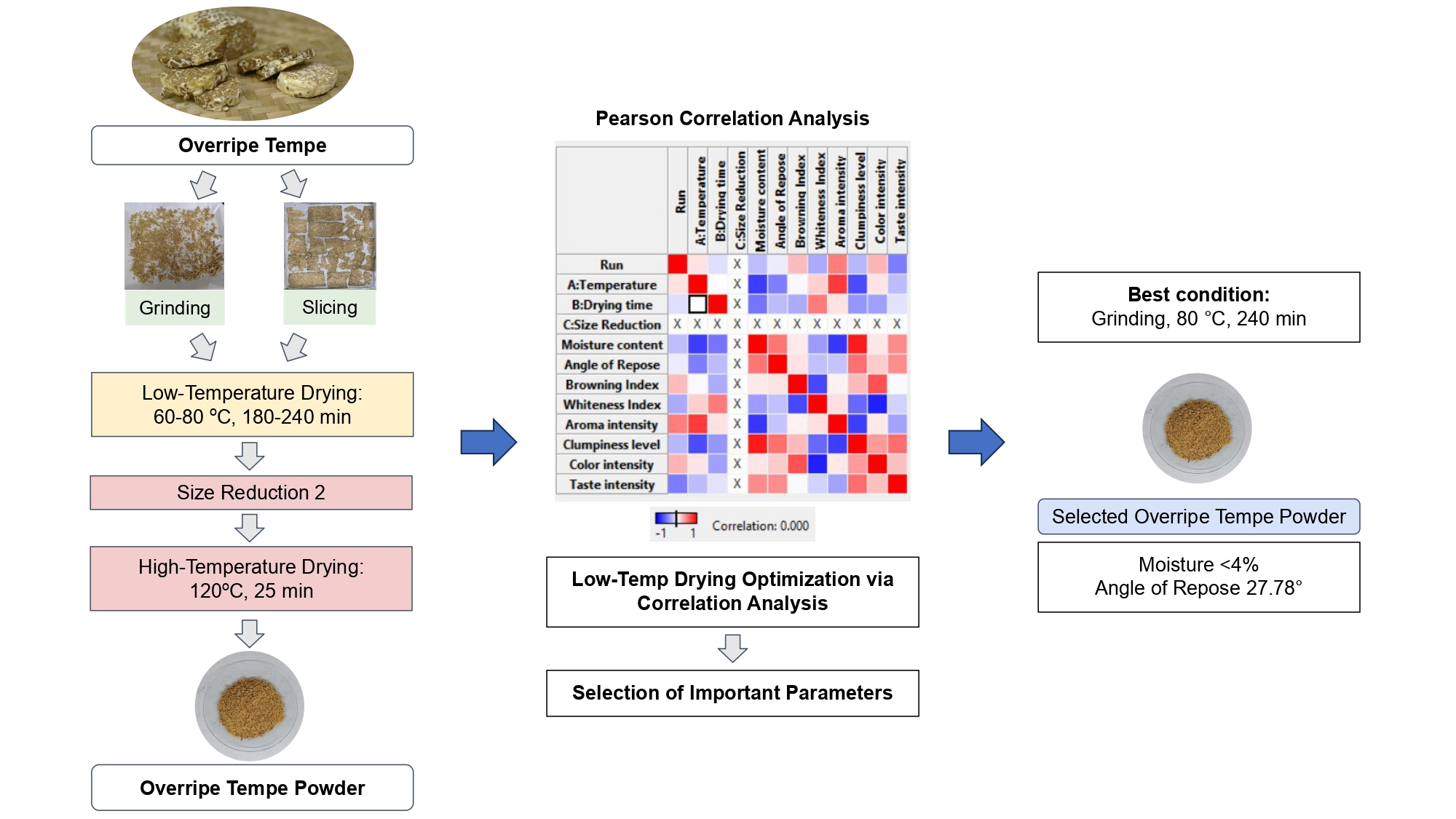
Tempe is a popular Indonesian plant-based protein source. Overripe tempe, an extended fermentation period of fresh tempe, has been explored as a flavor enhancer in various Indonesian cuisines. This study aimed to determine the optimal processing conditions for overripe tempe powder using RSM and central composite design in Design Expert 13.0®. Drying temperature (60°C - 80°C) and time (180 - 240 min) were tested as numerical factors, while sample shape (slices or pellets) was a categorical factor, resulting in 20 randomized experiments. The quality parameters of the produced powder—moisture content, angle of repose, browning index, whiteness index, and sensory attributes (clumpiness, color, aroma, and taste intensity)—were used to develop model equations. Correlation analysis of the models showed that drying temperature and time significantly influenced moisture content, clumpiness, and aroma intensity. Optimization of the response models identified grinding and drying at 80°C for 240 min as the best conditions. Validation confirmed that the resulting powder met the regulated moisture content standard and offered benefits such as shorter drying time and improved flowability compared to previous methods.
Drying; Overripe tempe powder; Powder quality; Response surface methodology; Size reduction
Akhtaruzzaman, M., Mondal, M. H. T.,
Sarker, M. S. H., Biswas, M., Shanta, S. A. A., & Sheikh, M. A. M. (2022).
Evaluation of drying characteristics, energy consumption and quality of
parboiled paddy: Two stage drying. Journal of Agriculture and Food Research,
8, 100284. https://doi.org/10.1016/j.jafr.2022.100284
Andriani, M., Baskoro, K., & Nurhartadi, E. (2014). Studies on
physicochemical and sensory characteristics of overripe tempeh flour as food
seasoning. Academic Research International, 5(5), 36–45.
AOAC. (2005). Official methods of
analysis. Association of Official Analytical Collaboration International.
Arifan, F., Dewi, A. L., Yudanto, Y.
A., Sapatra, E. F., Broto, R. T. D. W., Sutaryo, & Sumardiono, S. (2022).
Effect of thermal pretreatment of pineapple peel waste in biogas production
using response surface methodology. International Journal of Technology, 13(3),
619–632. https://doi.org/10.14716/ijtech.v13i3.4747
ASTM. (2005). Standard test method
for measuring the angle of repose of free-flowing mold powders ASTM C1444-00.
American Society for Testing and Materials.
Bourdoux, S., Li, D., Rajkovic, A.,
Devlieghere, F., & Uyttendaele, M. (2016). Performance of drying
technologies to ensure microbial safety of dried fruits and vegetables. Comprehensive
Reviews in Food Science and Food Safety, 15, 1056–1066. https://doi.org/10.1111/1541-4337.12224
BSN. (1996a). SNI 01-4273-1996:
Bumbu rasa sapi (Beef flavored seasoning). https://akses-sni.bsn.go.id/viewsni/baca/8568
BSN. (1996b). SNI 01-4281-1996:
Bumbu rasa ayam (Chicken flavored seasoning). https://akses-sni.bsn.go.id/viewsni/baca/1741
Ergüne?, G., & Tarhan, S. (2006).
Color retention of red peppers by chemical pretreatments during greenhouse and
open sun drying. Journal of Food Engineering, 76(3), 446–452. https://doi.org/10.1016/j.jfoodeng.2005.05.046
Errat, F. N. (2022). Upscaling
evaluation of dried overripe tempe for the production process plant-based
instant stock (Master’s thesis). Swiss German University, Tangerang.
Esraa, A., Putra, A., Mosa, A., Dan, R.
M., & Attia, O. H. (2022). An empirical model for optimizing the sound
absorption of single layer MPP based on response surface methodology. International
Journal of Technology, 13(3), 496–507. https://doi.org/10.14716/ijtech.v13i3.5507
Gunawan Puteri, M. D. P. T., Fortunata,
S. A., Prabawati, E. K., Kristianti, F., & Wijaya, C. H. (2018). Overripe
tempe as source of protein in development of ready-to-eat porridge. International
Food Research Journal, 25. https://api.semanticscholar.org/CorpusID:209954522
Gunawan-Puteri, M. D. P. T., Christli,
L., Prabawati, E. K., & Marpaung, A. M. (2018). Development of rice
porridge with overripe tempeh extract for infants. In R. Nur et al. (Eds.), Advances
in Engineering Research (pp. 188–193). https://doi.org/10.2991/fanres-18.2018.39
Gunawan-Puteri, M. D. P. T., Hassanein, T. R., Prabawati, E. K., Wijaya, C.
H., & Mutukumira, A. N. (2015). Sensory characteristics of seasoning
powders from overripe tempeh. Procedia Chemistry, 14, 263–269. https://doi.org/10.1016/j.proche.2015.03.037
Gunawan-Puteri, M. D. P. T., Samuel,
K., Felicya, Kartawiria, I. S., & Wijaya, C. H. (2017). Potential
application of overripe tempe dried powder as plant-based instant stock. Proceeding
International Postgraduate Symposium on Food, Agriculture, and Biotechnology
(IPSFAB) 2017, 34–44. https://doi.org/10.14457/MSU.res.2017.20
Harefa, A. P. P. (2020). Pengembangan
nugget berbahan tempe busuk untuk remaja (Master’s thesis). IPB University,
Bogor.
Hassanein, T. R., Prabawati, E. K.,
& Gunawan-Puteri, M. D. P. T. (2015). Analysis of chemical and microbial
changes during storage of overripe tempeh powder as seasoning material. International
Journal of Science and Engineering, 8(2), 131–134.
Herawati, H., Kamsiati, E., Afifah, D.
N., Kusumaningtyas, E., Bachtiar, M., Sunarmani, & Agustinisari, I. (2023).
Characteristics of GABA, antioxidant, and sensory quality of modified tempeh. International
Journal of Food Properties, 26(2), 3532–3543. https://doi.org/10.1080/10942912.2023.2290440
Herawati, H., Kamsiati, E., &
Sunarmani. (2021). Formulation of food ingredients to characteristics of
gluten-free noodles. International Journal of Technology, 12(3),
602–612. https://doi.org/10.14716/ijtech.v12i3.4139
Ismail, S. N. A. S., Ishak, M. A. M.,
Ahmad, R., & Ismail, K. (2025). Impact of optimized molar ratio,
temperature and time on organic sulfur transformation and thermophysical
properties of high-sulfur coal. International Journal of Technology, 16(2),
395–410. https://doi.org/10.14716/ijtech.v16i2.7257
Koç, B., Koç, M., & Baysan, U.
(2021). Food powders bulk properties. In E. Ermi? (Ed.), Food Powders:
Properties and Characterization (p. 17). Springer. https://doi.org/10.1007/978-3-030-48908-3
Kustyawati, M. E., Subeki, Murhadi,
Rizal, S., & Astuti, P. (2020). Vitamin B12 production in soybean
fermentation for tempeh. AIMS Agriculture and Food, 5(2), 262–271. https://doi.org/10.3934/agrfood.2020.2.262
Kusumawaty, N., Sulaeman, A.,
Marliyati, S. A., & Laily, N. (2020). Cookies from tempeh semangit as
supplemental food for pregnant women. In Proceedings of the 1st IPB
International Conference on Nutrition and Food 2020 (pp. 107–108).
Kusumawaty, N., Sulaeman, A., Marliyati, S. A., Laily, N., & Fitriyah,
H. (2023). The effect of semangit tempeh cookies on MUAC, Hb, and serum
ferritin. Jurnal Gizi Pangan, 18, 108–110. https://doi.org/10.25182/jgp.2023.18.Supp.1.108-110
Metty, Inayah, Widiany, F. L., &
Shayida, H. (2022). Analisis
kesukaan tepung tempe semangit... Prosiding Seminar Nasional Universitas
Respati Yogyakarta, 49–53.
Mulyana, Susanto, W. H., & Purwantiningrum, I. (2014). Pengaruh
proporsi tepung tempe semangit terhadap karakteristik kerupuk. Jurnal
Pangan dan Agroindustri, 2(4), 113–120.
Namsanguan, Y., Tia, W., Devahastin,
S., & Soponronnarit, S. (2004). Drying kinetics of shrimp undergoing
two-stage drying. Drying Technology, 22(4), 759–778. https://doi.org/10.1081/DRT-120034261
Nuraini, V., Puyanda, I., Kunciati, W.,
& Margareta, L. (2022). Perubahan
kimia dan mikrobiologi tempe busuk selama fermentasi. Jurnal
Agroteknologi, 15, 127–137. https://doi.org/10.19184/j-agt.v15i02.25729
Ostermeier, R., Parniakov, O., Töpfl,
S., & Jäger, H. (2020). Applicability of pulsed electric field
pre-treatment for a convective two-step drying process. Foods, 9(4). https://doi.org/10.3390/foods9040512
Pamungkas, S. (2022). Hubungan
penggunaan bumbu instan terhadap kepuasan konsumen di Kota Semarang
(Undergraduate thesis). Universitas Katolik Soegijapranata.
Paul, A., & Martynenko, A. (2022).
Effect of material thickness and humidity on EHD-dried apples. Foods, 11(18).
https://doi.org/10.3390/foods11182765
Rawat, S. (2015). Food spoilage:
Microorganisms and their prevention. Asian Journal of Plant Science &
Research, 5. https://api.semanticscholar.org/CorpusID:7269230
Rifna, E. J., & Dwivedi, M. (2021).
The microbiological safety of food powders. In E. Ermi? (Ed.), Food Powders:
Properties and Characterization (pp. 169–193). Springer. https://doi.org/10.1007/978-3-030-48908-3
Shofinita, D., Bindar, Y., Samadhi, T.
W., Jaelawijaya, A., Achmadi, A. B., & Theodric, D. (2024). Effect of
extraction and spray drying temperatures on bioactive compounds in red dragon
fruit skin. International Journal of Technology, 15(5), 1282–1291. https://doi.org/10.14716/ijtech.v15i5.6040
Shurtleff, W., & Aoyagi, A. (2022).
History of tempeh and tempeh products (1815–2000). Soyinfo Center.
Skowron, K., Budzy?ska, A.,
Grudlewska-Buda, K., Wiktorczyk-Kapischke, N., Andrzejewska, M.,
Wa?ecka-Zacharska, E., & Gospodarek-Komkowska, E. (2022). Two faces of
fermented foods. Frontiers in Microbiology, 13. https://doi.org/10.3389/fmicb.2022.845166
Torbica, A., Hadnaev, M., &
Dap?evi? Hadnaev, T. (2012). Rice and buckwheat flours related to cookie
quality. Food Research International, 48(1), 277–283. https://doi.org/10.1016/j.foodres.2012.05.001
US Food and Drug Administration
(USFDA). (2023). Food code 2022 [Viewed 11 Nov 2024].
Utami, R., Wijaya, C. H., & Lioe,
H. N. (2016). Taste of water-soluble extracts from over-fermented tempe. International
Journal of Food Properties, 19(9), 2063–2073. https://doi.org/10.1080/10942912.2015.1104509
Verevka, T., & Gao, Y. (2025).
Market valuation of high-tech companies in IT and automotive industries. International
Journal of Technology, 16(2), 585–601. https://doi.org/10.14716/ijtech.v16i2.7418
Yando, A., & Paramita, V. (2018). Studi pengaruh suhu dan ketebalan irisan terhadap karakteristik ubi kayu dan ubi jalar. METANA, 13(1), 23–29.