
Functional Modeling of Distributions of Substantive-Content Message Properties in the Information Background
Published at : 01 Dec 2025
Volume : IJtech
Vol 16, No 6 (2025)
DOI : https://doi.org/10.14716/ijtech.v16i6.7411
Konnikov, E.,
Rodionov, D., & Kryzhko, D. (2025). Functional modeling of
distributions of substantive- content message properties in the information
background. International Journal of Technology, 16 (6), 1911–1928.
| Evgenii Konnikov | Peter the Great St. Petersburg Polytechnic University, 29 Politechnicheskaya Ulitsa, St. Petersburg, 195251 Russia |
| Dmitriy Rodionov | Peter the Great St. Petersburg Polytechnic University, 29 Politechnicheskaya Ulitsa, St. Petersburg, 195251 Russia |
| Darya Kryzhko | Peter the Great St. Petersburg Polytechnic University, 29 Politechnicheskaya Ulitsa, St. Petersburg, 195251 Russia |
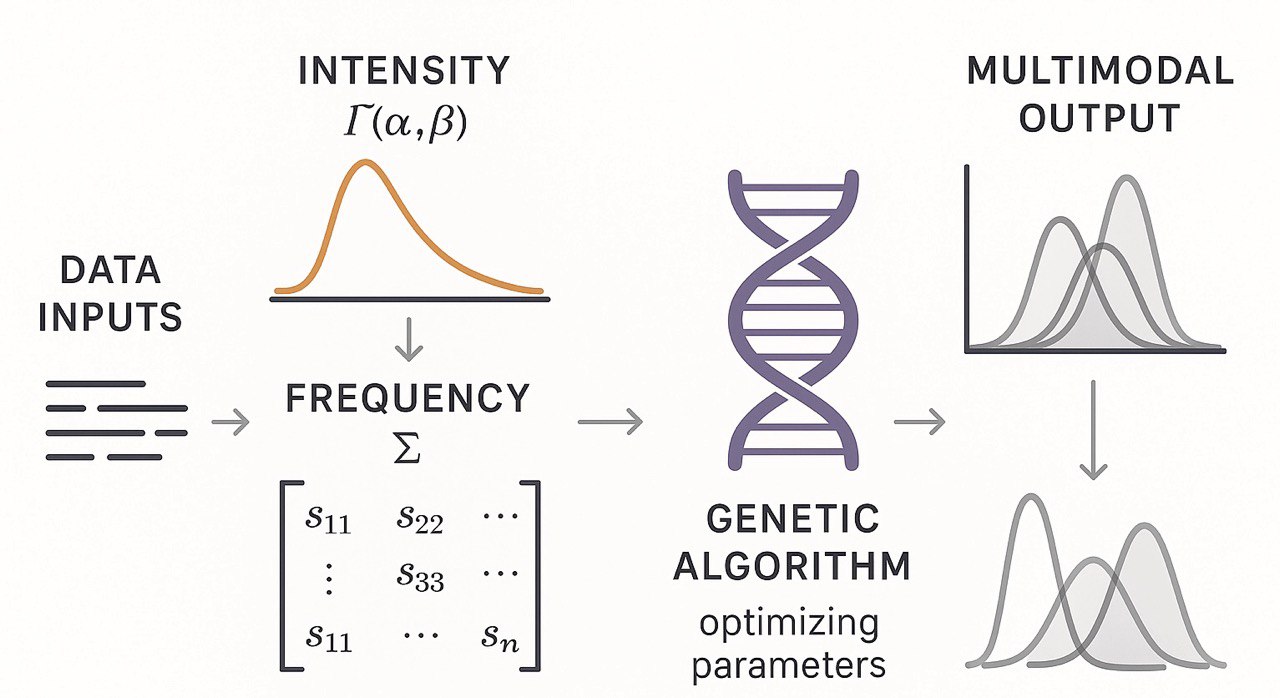
This paper presents a novel methodology for modeling the distribution of substantive-content message properties in the information background. This study develops a toolkit to analyze and predict information dynamics by identifying key themes, evaluating their importance, and understanding their connections. The proposed approach is based on the concept of multimodality, where properties are characterized by peaks of varying intensity and frequency. Intensity and frequency components are modeled separately and combined into a unified probabilistic framework; model parameters (shape and internal-covariance coefficients) are searched within the range (0,1). The genetic search uses mutation of ±20% with probability 50% and normalization of the intensity scale ( = 1). Model quality is assessed by the Mean Absolute Error between ranked histogram bins (discretization coefficient DC defines the number of bins). Intensity, reflecting the depth and saturation of the information signal, is modeled using the Gamma distribution, while frequency, reflecting the number of occurrences, is represented by the multivariate normal distribution. A genetic algorithm is employed to identify the optimal parameters for these distributions. The methodology offers a more comprehensive understanding of information dynamics by considering both intensity and frequency, and effectively handles complex interdependencies between properties. It can be applied to various domains, including social media analysis, political communication, and marketing, providing valuable insights for decision-making.
Information Background Analysis, Intensity of Presence, Substantive-Content Message, Symbolic Data Constructs, Thematic Analysis
| Filename | Description |
|---|---|
| R1-EECE-7411-20250603145413.pdf | --- |
Amur, Z., Hooi, Y., Bhanbhro, H.,
Dahri, K., & Soomro, G. (2023). Short-text semantic similarity (STSS):
Techniques, challenges and future perspectives. Applied Sciences, 13(6),
3911. https://doi.org/10.3390/app13063911
Anisiforov, A., Dubgorn, A., & Lepekhin, A. (2017). Organization of enterprise architecture information monitoring [Conference proceeding: E3S Web of Conferences, Vol. 110, 02051 (2019)]. Proceedings of the 29th International Business Information Management Association Conference, 2920–2930. https://doi.org/10.1051/e3sconf/201911002051
Bashir, H., Ojiako, U., Marshall, A.,
Chipulu, M., & Yousif, A. (2022). The analysis of information flow
interdependencies within projects. Production Planning & Control, 33(1),
20–36. https://doi.org/10.1080/09537287.2020.1821115
Berawi, M., Sari, M., Salsabila, A., Susantono, B., & Woodhead, R.
(2022). Utilizing building information modelling in the tax assessment
process of apartment buildings. International Journal of Technology, 13(7),
1515–1526. https://doi.org/10.14716/ijtech.v13i7.6188
Beth, E. (2012). Formal methods: An
introduction to symbolic logic and to the study of effective operations in
arithmetic and logic. Springer Science & Business Media.
Bharadwaj, A. (2000). A resource-based
perspective on information technology capability and firm performance: An
empirical investigation. MIS Quarterly, 24(1), 169–196. https://doi.org/10.2307/3250983
Biggers, F., Mohanty, S., & Manda,
P. (2023). A deep semantic matching approach for identifying relevant messages
for social media analysis. Scientific Reports, 13(1), 12005. https://doi.org/10.1038/s41598-023-38761-y
Boerman, S., Kruikemeier, S., &
Bol, N. (2021). When is personalized advertising crossing personal boundaries?
How type of information, data sharing, and personalized pricing influence
consumer perceptions of personalized advertising. Computers in Human
Behavior Reports, 4, 100144. https://doi.org/10.1016/j.chbr.2021.100144
Bruce, N., Murthi, B., & Rao, R.
(2017). A dynamic model for digital advertising: The effects of creative
format, message content, and targeting on engagement. Journal of Marketing
Research, 54(2), 202–218. https://doi.org/10.1509/jmr.14.0117
Cappella, J., & Li, Y. (2023).
Principles of effective message design: A review and model of content and
format features. Asian Communication Research, 20(3), 147–174. https://doi.org/10.20879/acr.2023.20.023
Cawsey, T., & Rowley, J. (2016).
Social media brand building strategies in B2B companies. Marketing
Intelligence & Planning, 34(6), 754–776. https://doi.org/10.1108/MIP-04-2015-0079
Clark, D., Hunt, S., & Malacaria,
P. (2007). A static analysis for quantifying information flow in a simple
imperative language. Journal of Computer Security, 15(3), 321–371. https://doi.org/10.3233/JCS-2007-15302
Constantiou, I., & Kallinikos, J.
(2015). New games, new rules: Big data and the changing context of strategy. Journal
of Information Technology, 30(1), 44–57. https://doi.org/10.1057/jit.2014.17
Copeland, B., & Fan, Z. (2023).
Turing and von Neumann: From logic to the computer. Philosophies, 8(2),
22. https://doi.org/10.3390/philosophies8020022
Damanpour, F. (2018). Organizational
innovation: A meta-analysis of effects of determinants and moderators. Organizational
Innovation, 34(3), 127–162. https://doi.org/10.5465/256406
Dehaene, S., & Cohen, L. (2011).
The unique role of the visual word form area in reading. Trends in Cognitive
Sciences, 15(6), 254–262. https://doi.org/10.1016/j.tics.2011.04.003
Eremina, I., Yudin, A., Tarabukina, T.,
& Oblizov, A. (2022). The use of digital technologies to improve the
information support of agricultural enterprises. International Journal of
Technology, 13(7), 1393–1402. https://doi.org/10.14716/ijtech.v13i7.6184
Goldberg, Y. (2022). Neural network
methods for natural language processing. Springer. https://doi.org/10.1007/978-3-031-02165-7
Hitt, M., Hoskisson, R., & Ireland, R. (2019). Strategic
management: Concepts and cases: Competitiveness and globalization. Cengage
Learning.
Hsieh, Y.-C., & Chen, K.-H. (2011).
How different information types affect viewer’s attention on internet
advertising. Computers in Human Behavior, 27(2), 935–945. https://doi.org/10.1016/j.chb.2010.11.019
Kushwaha, A., Kar, A., & Dwivedi,
Y. (2021). Applications of big data in emerging management disciplines: A
literature review using text mining. International Journal of Information
Management Data Insights, 1(2), 100017. https://doi.org/10.1016/j.jjimei.2021.100017
Li, P., Jinyi, L., Xiangyi, L., Yao,
X., & Ziguo, W. (2024). Digitalization as a factor of production in China
and the impact on total factor productivity (TFP). Systems, 12(5), 164. https://doi.org/10.3390/systems12050164
Li, Y., Chang, Y., & Liang, Z.
(2022). Attracting more meaningful interactions: The impact of question and
product types on comments on social media advertisings. Journal of Business
Research, 150, 89–101. https://doi.org/10.1016/j.jbusres.2022.05.085
Li, Z., Wenquan, W., & Qingguo, M.
(2023). The adjustment of pressure perception in e-government response: A
perspective of the political system theory. Systems, 11(3), 158. https://doi.org/10.3390/systems11030158
Lim, S., & Schmälzle, R. (2023).
Artificial intelligence for health message generation: An empirical study using
a large language model (LLM) and prompt engineering. Frontiers in
Communication, 8, 1129082. https://doi.org/10.3389/fcomm.2023.1129082
Lytras, M., Visvizi, A., Zhang, X.,
& Aljohani, N. (2020). Cognitive computing, big data analytics and
data-driven industrial marketing. Industrial Marketing Management, 90,
663–666. https://doi.org/10.1016/j.indmarman.2020.03.024
Mueller, M., & Grindal, K. (2019).
Data flows and the digital economy: Information as a mobile factor of
production. Digital Policy, Regulation and Governance, 21(1), 71–87. https://doi.org/10.1108/DPRG-08-2018-0044
Nadkarni, P., Ohno-Machado, L., &
Chapman, W. (2011). Natural language processing: An introduction. Journal of
the American Medical Informatics Association, 18(5), 544–551. https://doi.org/10.1136/amiajnl-2011-000464
Nishiyama, A., Shigenori, T., Jack, A.
T., & Roumiana, T. (2024). Holographic brain theory: Super-radiance, memory
capacity and control theory. International Journal of Molecular Sciences, 25(4),
2399. https://doi.org/10.3390/ijms25042399
Nugraha, E., Sari, R., Sutarman, Y.,
Yunan, A., & Kurniawan, A. (2022). The effect of information technology,
competence, and commitment to service quality and implication on customer
satisfaction. International Journal of Technology, 13(4), 827–836.
https://doi.org/10.14716/ijtech.v13i4.3809
Oberg, C. (2023). Neuroscience in
business-to-business marketing research: A literature review, co-citation
analysis and research agenda. Industrial Marketing Management, 113,
168–179. https://doi.org/10.1016/j.indmarman.2023.06.004
Omar, Y., & Peter, P. (2020). A
survey of information entropy metrics for complex networks. Entropy, 22(12),
1417. https://doi.org/10.3390/e22121417
Onykiy, B., Antonov, E., Artamonov, A.,
& Tretyakov, E. (2020). Information analysis support for decision-making in
scientific and technological development. International Journal of
Technology, 11(6), 1125–1135. https://doi.org/10.14716/ijtech.v11i6.4465
Qiu, Q., Hao, Z., & Jiang, L.
(2022). Strategic information flow under the influence of industry structure. European
Journal of Operational Research, 298(3), 1175–1191. https://doi.org/10.1016/j.ejor.2021.08.041
Rodionov, D., Gracheva, A., Konnikov, E., Konnikova, O., & Kryzhko, D.
(2022). Analyzing the systemic impact of information technology
development dynamics on labor market transformation. International Journal
of Technology, 13(7), 1548–1557. https://doi.org/10.14716/ijtech.v13i7.6204
Rodionov, D., Kryzhko, D., Tenishev,
T., Uimanov, V., Abdulmanova, A., Kvikviniia, A., & Konnikov, E. (2022).
Methodology for assessing the digital image of an enterprise with its industry
specifics. Algorithms, 15(6), 177. https://doi.org/10.3390/a15060177
Rodionov, D., Zaytsev, A., Konnikov,
E., Dmitriev, N., & Dubolazova, Y. (2021). Modeling changes in the
enterprise information capital in the digital economy. Journal of Open
Innovation: Technology, Market, and Complexity, 7(3), 166. https://doi.org/10.3390/joitmc7030166
Smýkal, P., & Eric, W. (2023). A
commemorative issue in honor of 200th anniversary of the birth of Gregor Johann
Mendel: The genius of genetics. International Journal of Molecular Sciences,
24(14), 11718. https://doi.org/10.3390/ijms241411718
Stapleton, G., Howse, J., &
Rodgers, P. (2010). A graph theoretic approach to general Euler diagram
drawing. Theoretical Computer Science, 411(1), 91–112. https://doi.org/10.1016/j.tcs.2009.09.005
Vigo, R. (2013). Complexity over
uncertainty in generalized representational information theory (GRIT): A
structure-sensitive general theory of information. Information, 4(1), 1–30. https://doi.org/10.3390/info4010001
Wang, S., Zhang, Y., Shi, W., Zhang, G., Zhang, J., Lin, N., & Zong, C.
(2023). A large dataset of semantic ratings and its computational
extension. Scientific Data, 10(1), 106. https://doi.org/10.1038/s41597-023-01995-6
Weaver, W. (2017). The mathematics of
communication. In Communication theory (pp. 27–38). Routledge.
Weinlich, P., & Semerádová, T.
(2022). Emotional, cognitive and conative response to influencer marketing. New
Techno Humanities, 2(1), 59–69. https://doi.org/10.1016/j.techum.2022.07.004
Zaytsev, A., Rodionov, D., Dmitriev, N., & Kichigin, O. (2019). Comparative analysis of results on application of methods of intellectual capital valuation. In International Scientific Conference: Digital Transformation on Manufacturing, Infrastructure and Service (DTMIS 2019).